Towards sustainable agriculture and agricultural entrepreneurship through quality education in Kenya – HAMK joins to develop an Open Distance Learning Campus

There are vast untapped entrepreneurial opportunities in Kenyan agriculture. The sector has a critical need for qualified professionals. One factor limiting the development of local entrepreneurship is the lack of high-quality education available for those interested in starting a business. Entrepreneurship education offered by universities is not sufficiently encouraging for launching one’s own enterprise. Entrepreneurs working in agriculture play a key role not only in job creation but also in mitigating and adapting to climate change. Open, accessible, high-quality education based on entrepreneurship and sustainability is an important factor in advancing these themes.
In Kenya, agriculture is the backbone of food security, climate change response, and above all, job creation. The population is growing rapidly, and most Kenyans are young. Among them are both educated and uneducated youth who struggle to find employment. Securing work is particularly difficult for those without formal education. Opportunities for further education are also limited for those already in working life, and in rural village communities access to education is very challenging. Open, university‑provided online courses focusing on entrepreneurship offer a way to improve access to high‑quality education.
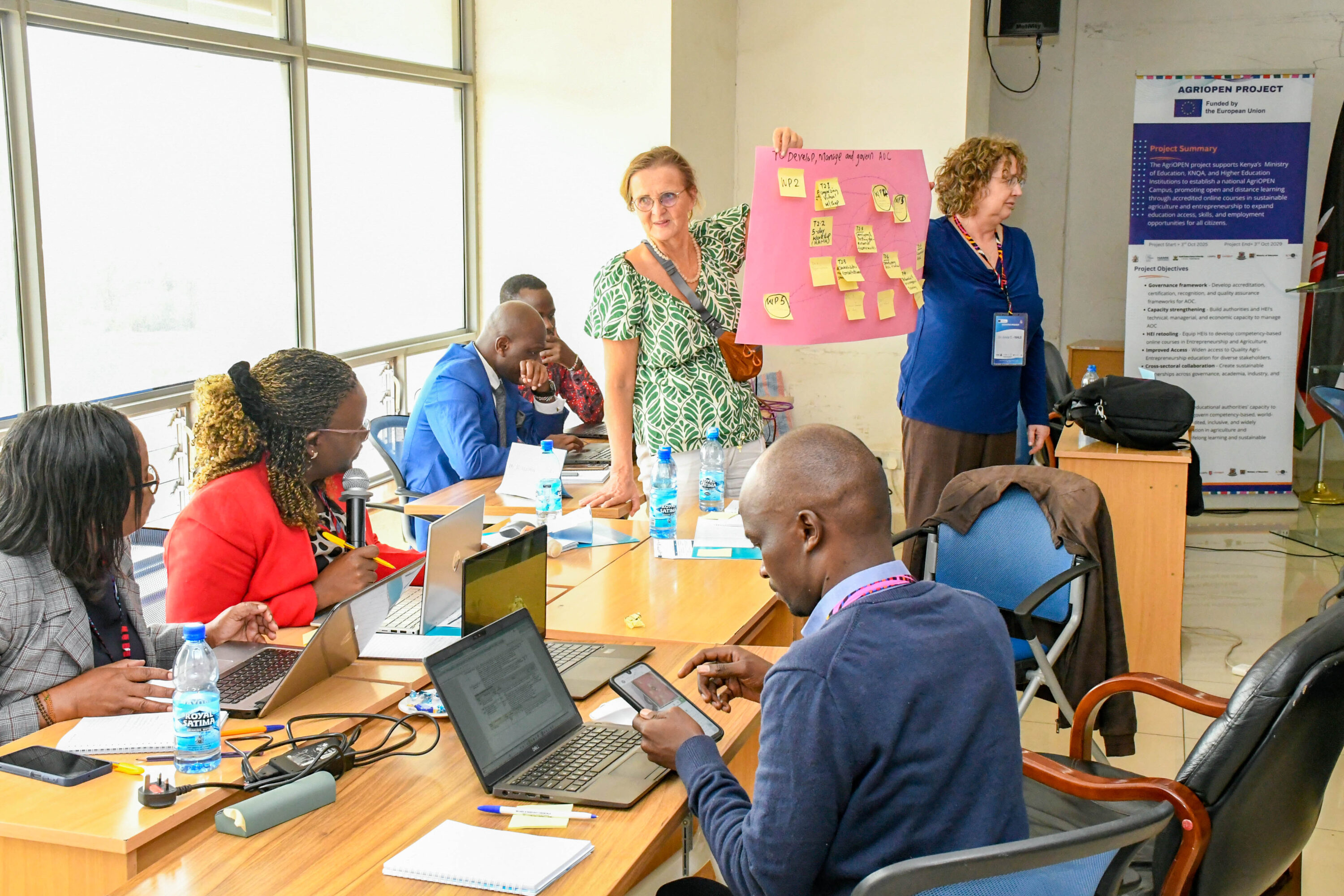
HAMK has joined as a project partner in the four-year AgriOPEN project coordinated by the University of Nairobi, through which we are building an online learning platform in Kenya. This will enable all Kenyans to participate in open university courses. Our project aims to strengthen Kenya’s education system and agricultural education, thereby promoting lifelong learning and sustainable national development. The Ministry of Education of Kenya and the national authority responsible for the quality of university education are also involved in the project.
Accessible, life-long learning to support the agricultural industry
The courses and teaching will be provided by several strong universities that specialize in agricultural education. The concept follows the European model of open university studies, where anyone can study for a small fee. Students may choose individual courses that suit their specific needs, but it is also possible to compile a larger study module. As in Europe, courses completed through open studies in Kenya can be accredited towards a degree if the student later applies for and is admitted to a degree programme.
The course offering developed within the project focuses on entrepreneurship courses with a sustainability theme. In Kenya, the agricultural sector is seen as having significant employment potential through processing and value addition. There are also emerging opportunities in digital and data-driven work, and circular economy principles open new avenues for agricultural development. Agriculture is considered the sector with the greatest number of entrepreneurial opportunities in Kenya.
Making open course offerings accessible to all citizens significantly improves access to learning and education. Currently, only a small proportion of young people can access technical education, and university studies are available to very few. Through the open course offering, we bring a human‑rights‑based approach into education: everyone has the right to high‑quality learning education.
European and Kenyan expertise brought together
In Kenya, education is provided by both public institutions and private education providers. Access to information can at times be challenging, and because education is fee‑based, its reliability is particularly important.
Together with another European partner, the Dutch NHL Stenden University of Applied Sciences, we bring a wide range of expertise to the project. The EU partners provide consultation for building the online platform. Our role also includes training higher education staff so that they can design course content and high-quality teaching that promote practical skills and entrepreneurship. We combine European and Kenyan expertise as we develop models that integrate companies and civil society organizations into the planning and delivery of education.
The AgriOPEN project is funded by the European Union through the Erasmus+ programme for Capacity Building in Higher Education.
Overview
Name: Campus for Access to Quality Education in Kenya for agri-sector sustainability and jobs (AgriOPEN)
Funding: Erasmus+ CBHE
Duration: 1st October 2025 – 30th September 2029
Budget: 1 155 842,89 € (HAMK’s share 227 331 €)
Partners: University of Nairobi (leading partner), Ministry of Education, Science and Technology (Kenya), the Kenya National Qualifications Authority, Egerton University, Laikipia University, South Eastern Kenya University (Kenya), Häme University of Applied Sciences (Finland) and NHL Stenden University of Applied Sciences (Netherlands).
Beneficiaires: The Inter-University Council for East Africa (IUCEA), The Regional Universities Forum for Capacity Building in Agriculture (RUFORUM), Kenya National Farmers Federation (KENAFF), Kenya Private Sector Alliance (KEPSA), and the County Government of Kitui

Towards sustainable agriculture and agricultural entrepreneurship through quality education in Kenya – HAMK joins to develop an Open Distance Learning Campus