Improving Warehouse Efficiency with a Smart Forklift Monitoring System
My name is Duxing Li, and I am a third-year ICT Bioeconomy student at HAMK’s Forssa campus. During a development project with Stera Technologies, I helped develop a smart forklift monitoring system that uses IoT technology to improve warehouse efficiency and make forklift use easier to track.
During our development project with Stera Technologies, I worked as the Product Owner. Our project focused on improving warehouse efficiency by developing a smart forklift monitoring system. In simple terms, the goal was to help workers and logistics managers better understand where forklifts are, whether they are in use, and when they are not being used efficiently.
At Stera, forklifts were sometimes left in unknown locations, and workers had to spend time searching for available vehicles. There was also no clear visibility into forklift downtime, which made it harder to identify inefficiencies in daily warehouse operations.
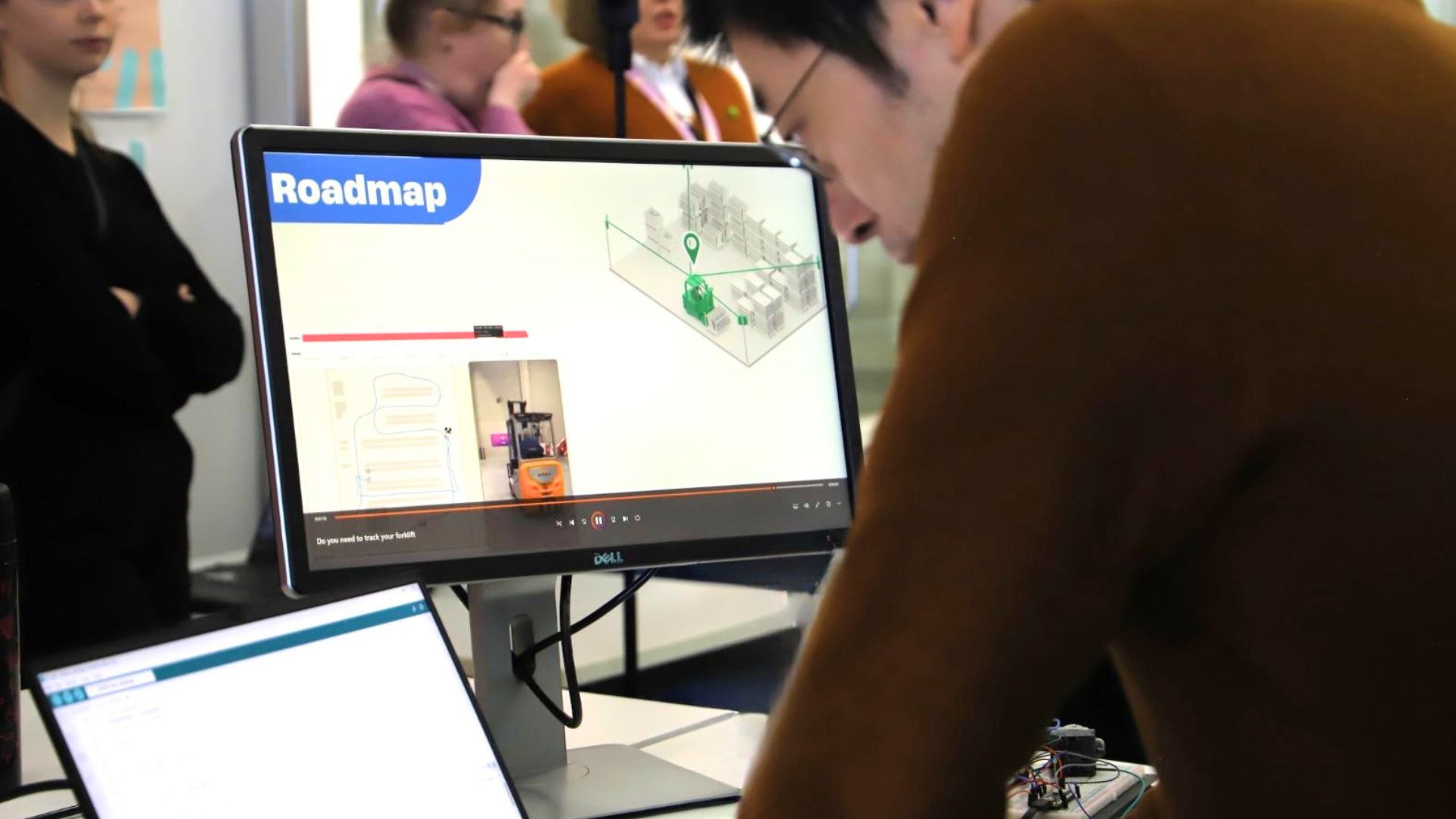
To solve this, our team developed an IoT-based prototype that collects data from forklifts and sends it to a cloud platform. The data is then displayed on clear dashboards that are easy to understand, also for non-technical users.
One part of the solution was a simple indicator light system inspired by taxi roof lights. We mounted an LED light on top of the forklift and added a button for the driver to press when taking the forklift into use. When the button is pressed, the light turns on, so workers can see from a distance whether the forklift is occupied.
The system also used Bluetooth Low Energy signals, a motion sensor and the ThingsBoard cloud platform to monitor forklift activity. By combining this data, the system can classify forklift activity into different states, such as parked, idle, working or driving. This helps identify downtime and supports better decision-making in warehouse logistics.
During the project, we also learned how important it is to adapt technical ideas to real working environments. At first, we considered other solutions, such as overhead indicator lights and camera-based QR code scanning. After discussions with the client, we balanced technical possibilities with practical industrial needs and adapted the solution based on client feedback. We chose a simpler IoT approach that could fit into the current working process, while also showing how IT systems can gradually change and improve production workflows.
This project also inspired me to explore the topic further in my Big Data course. I later simulated around 280,000 rows of forklift movement data to study how this type of system could support movement analysis and possible fault prediction in the future.
Compared with some of my earlier school projects, such as water quality monitoring and smart cycling gloves, this project was guided by a real industrial need. For me, the most interesting part was seeing how different technologies could be combined into one practical solution. The experience taught me that a successful technical project is not only about building a working system, but also about understanding the user’s needs and creating something that can bring real value. After demonstrating the prototype, we received positive feedback from Stera, and the solution has potential for future development.
Educational programme: Information and Communication Technology, Bioeconomy
Project implementation period: October 2025 to December 2025.
More Information