Global challenges such as clean water accessibility call for collaborative, interdisciplinary, and intercultural development of solutions. Recognizing this, HAMK Design Factory (HAMKDF) and Pace University’s NYC Design Factory set up a joint initiative and an international pilot course. During the course, students from diverse fields in Finland and the United States worked remotely together to design an innovative, civilian-friendly water quality information system. Building on the promising outcomes of this pilot, the collaboration expanded further into a pioneering joint application for the Millennium Fellowship, with a unified mission focused on advancing clean water and sanitation. This marks the first time an international, multi-institution team applied together for the fellowship. This article examines our collaborative project to discuss how international design-based learning can foster impactful solutions, strengthen institutional partnerships, and contribute to global water stewardship efforts.
Background – From International Design Factory Week to collaboration
First discussions on the co-creation project between HAMKDF and NYC Design Factory started at the International Design Factory Week (IDFW), organized in Ankara in October 2023. The event provided a valuable opportunity to exchange experiences and knowledge, compare ongoing initiatives and identify shared interests, and plan new projects. During the discussions at the event, we realized that both HAMK and Pace University had been conducting student projects related to water quality and clean water technologies. In HAMK, we were working on real-time water quality monitoring of Lake Katumajärvi, where students developed sensors and applications for monitoring water quality. At the same time, NYC Pace Design Factory, together with Blue CoLab, had conducted several student projects on clean water. In addition, Design Factories from both institutions had been involved in the Horizon 2020 (European Commission, 2020) funded ATTRACT project (ATTRACT, 2023) which facilitated student projects that explored societal applications of developed breakthrough technologies in new domains. This got us excited to together co-create a joint project.
Based on our good experiences with the Shenkar Design Factory (Siintoharju, 2023), in 2024 we decided to apply with NYC Design Factory Director, Clinical Professor Andreea Cotaranu for the European Commission funding for “KA171 Mobility of higher education students and staff” (European Commission, 2023) to enable student and staff exchanges between HAMK and Pace University.
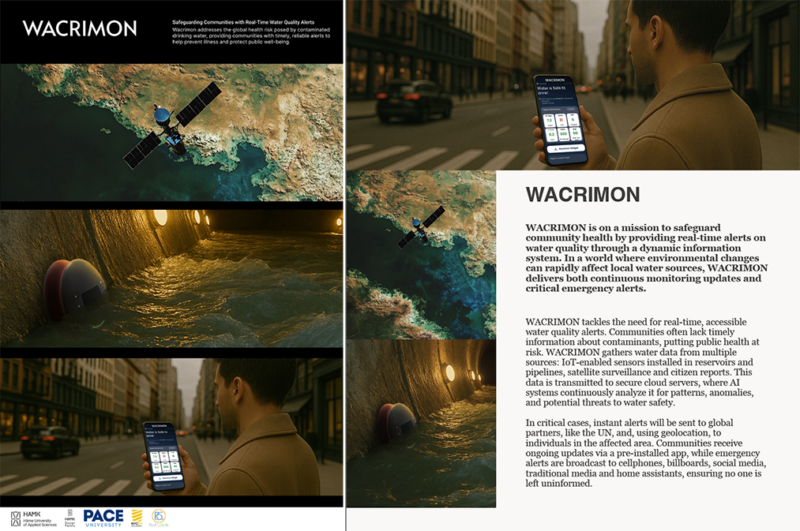
After these initial steps of planning the EC mobility funding, in early 2025 HAMKDF and Pace University NYC Design Factory started a pilot where students from various fields of study worked on developing an innovative solution to create accessible clean water information systems for civilians. The need to solve this challenge originated from shared observations of water quality by both Design Factories. The New York team was looking into clean drinking water in the state of New York and the team in Finland was looking into getting more real-time information about condition and algae situation of lakes in Hämeenlinna. These observations were then brought to the joint student team, and their task was to explore how we might provide an up-to-date information system that could provide real-time data for civilians about their drinking water and/or their lakes’ cleanliness (Figure 1). This project lasted for three months, during which the students worked as a team on their own time but also got together once a week with the teaching staff. The purpose of these interactions with the teaching staff was to give the students new assignments to ensure that they progressed in their project in a way that used the design thinking process as the backbone for development.
From a pilot to a Millenium Fellowship project
The pilot course confirmed that remotely conducted international collaboration was productive between our universities, and this set the stage for initiating a deeper and broader collaboration through the Millenium Fellowship program. The Millenium Fellowship is a semester-long leadership development program which allows students to participate remotely from their own campus, in this way making it possible to take their social impact project ideas to the next level. To support this, the network provides access to world-class training, connections, and recognition.
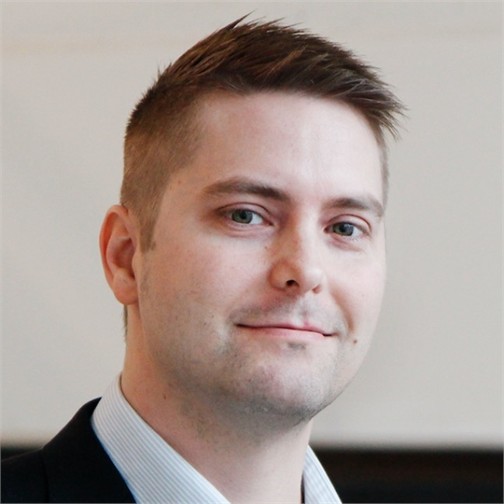
Pace University already had earlier experience of the programme from multiple iterations facilitated by Professor John Cronin and his student teams. Based on the experience from our pilot course, the idea between HAMK DF and Pace University was to gather students from both universities to jointly apply to the Millenium Fellowship programme, making this the first time an international team from several institutions applied to the programme. HAMK DF was able to gather seven students from various fields of study at HAMK, and Pace University brought in their own student group for this collaboration (Figure 2).
The international student team applied for the Millenium Fellowship program with a shared goal statement for their project idea, focusing on how the proposed partnership between HAMK and Pace University as a basis for the application is unique, and how it will enable intensive collaboration through remote work even though the schools are physically far apart. In the application, they explained that the project would in its part address the United Nations’ sustainable development goal 6 (SDG6) of ensuring access to water and sanitation for all (United Nations, 2025). The application also explained how that the project “will build upon the work of Pace’s 2024 team which found that the combined population of the world’s 25,000 higher education institutions an estimated 270 million water users would place it fourth on the list of the world’s most populous nations,” arguing that already these statistics support the need to increase awareness of water use.
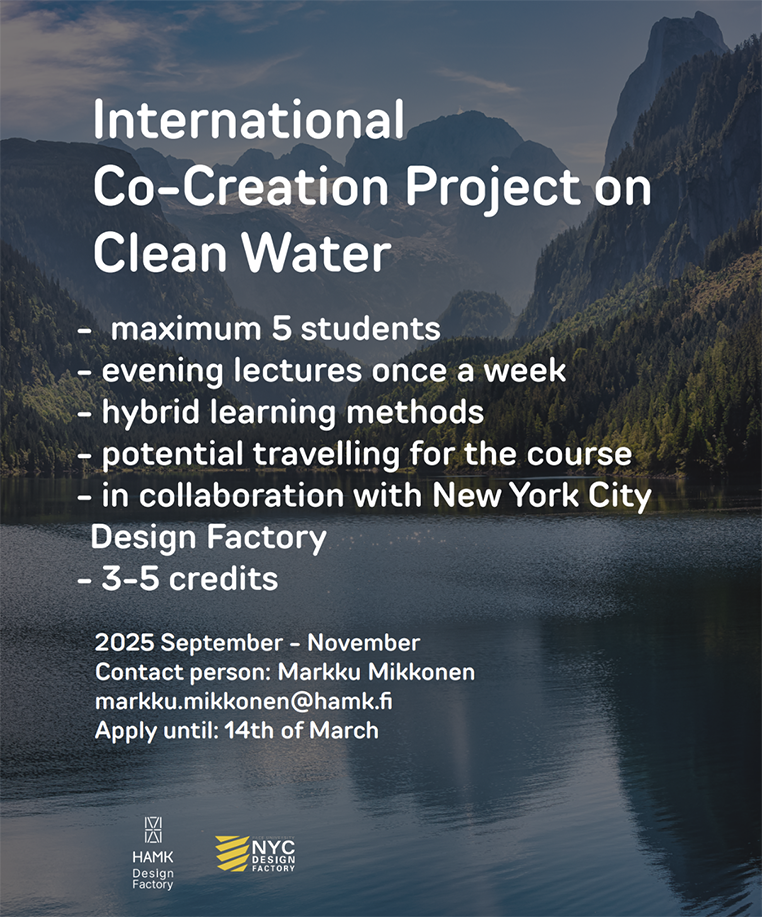
As the project was accepted into the Millennium Fellowship, collaboration through the Millennium Campus Network offered the students the necessary training for building their project ideas toward their SDG6 goal of helping clean water and sanitation. Together with this support from the network, both HAMKDF’s Markku Mikkonen and Pace University’s Professor Cronin supported the student needs for building their ideas into a concrete and testable forms.
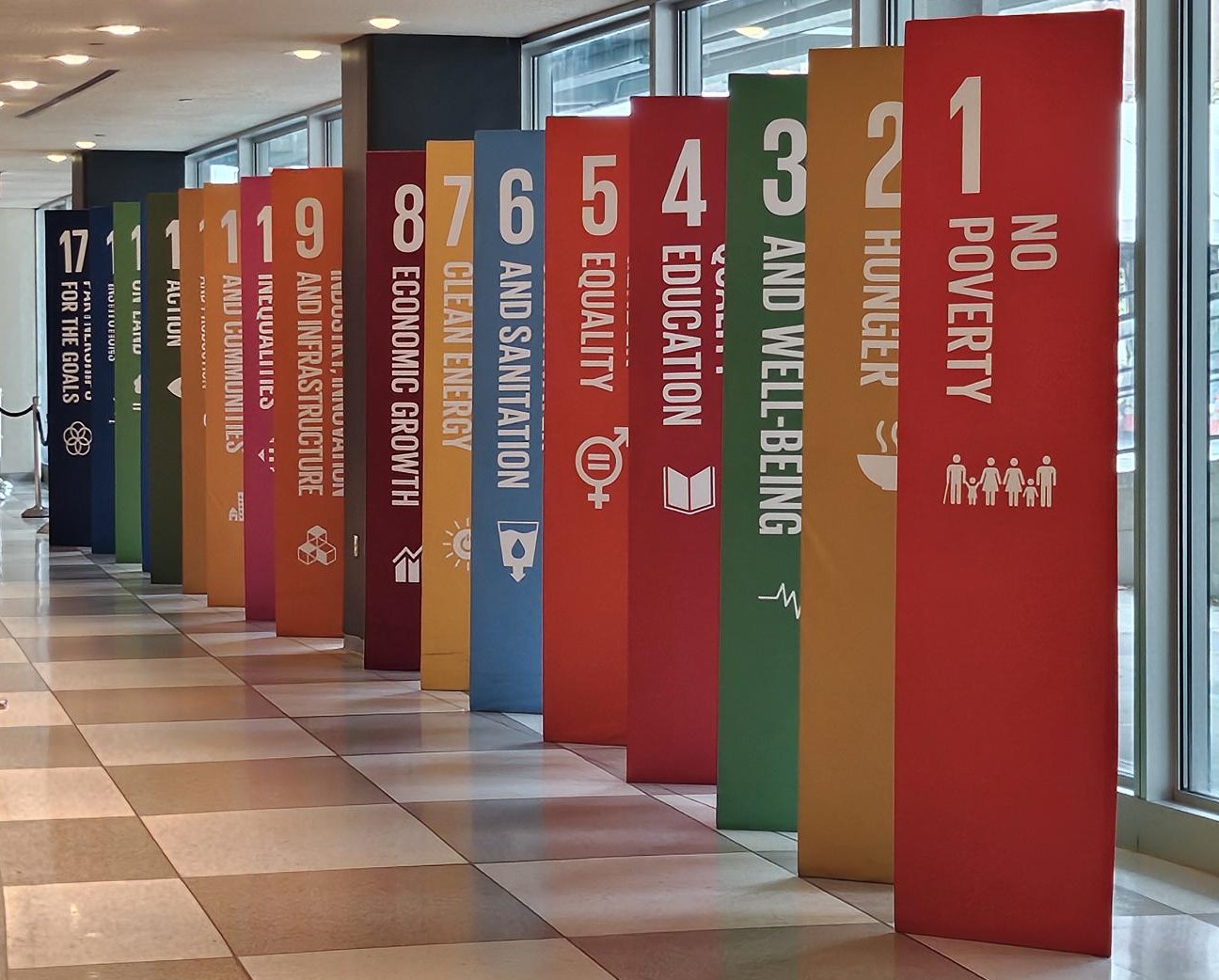
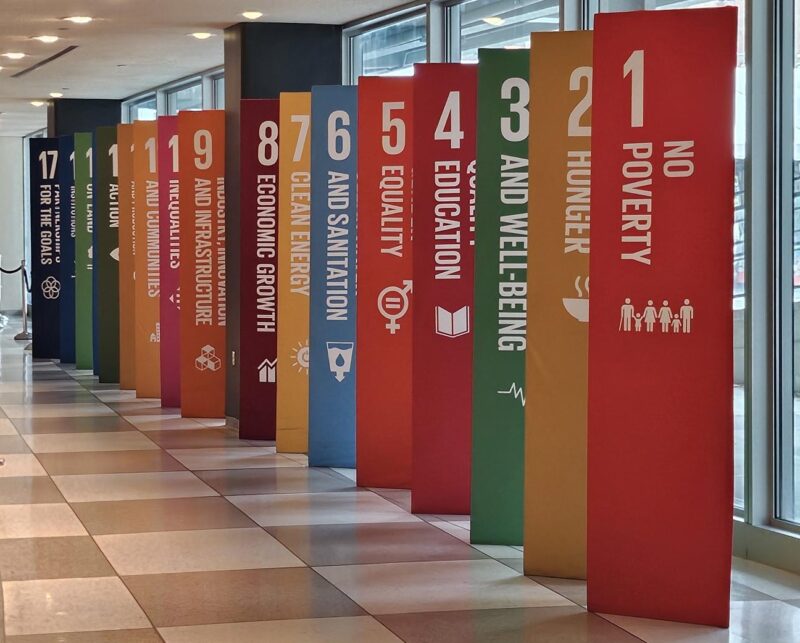
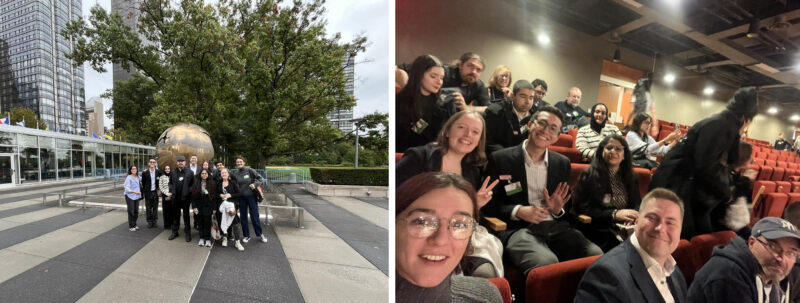
The students participating in this collaboration also gained the opportunity to travel to both locations and in this way build their understanding of the cultures and methods of access to clean water and sanitation in both countries. During this trip, the students also visited the United Nations in New York, and received further training on the drivers towards sustainable development (Figures 3 and 4).
Based on their MCN studies, further research, and their goal statement, the students at both universities concluded that they wish to focus on building awareness about clean water with different methods. Their plan for reaching the project goal consists of using different activities and marketing methods to effectively build this awareness for different people from different countries. At the time of writing, this project has not yet concluded, but the students are getting close to the finishing line with their different solution ideas.
Conclusion – Learning global collaboration for impactful solutions
The collaboration between HAMKDF and Pace University NYC Design Factory demonstrates how remotely executed international and interdisciplinary teamwork can meaningfully advance solving shared global challenges. What began as a small pilot course evolved into a pioneering Millennium Fellowship initiative, demonstrating that students across continents can not only co-create but also develop impactful solutions aligned with goals for sustainable development. Through sustained guidance, design-thinking methods, and intercultural exchange over boundaries, the student teams transformed their initial concept of a water information system into a broader mission: raising awareness about clean water through accessible, adaptable, and locally relevant approaches. As a result, the experience deepened institutional connections, expanded the students’ global perspectives, and laid the foundation for continued collaboration. Most importantly, it highlighted the potential for joint academic efforts to influence water awareness and stewardship both within the students’ home universities and on the global stage.
References
- ATTRACT Project. (2023). Summary & highlights – ATTRACT Phase 1. https://attract-eu.com/attract-phase-1/summary-highlights/
- European Commission. (2020). Horizon 2020. European Commission. https://research-and-innovation.ec.europa.eu/funding/funding-opportunities/funding-programmes-and-open-calls/horizon-2020_en
- European Commission. (2023). KA171 Mobility of higher education students and staff supported by external policy funds application – Erasmus+ & European Solidarity Corps guides. EC Public Wiki. https://wikis.ec.europa.eu/spaces/NAITDOC/pages/71926067/KA171+Mobility+of+higher+education+students+and+staff+supported+by+external+policy+funds+application
- Millennium Fellowship. (n.d.). Retrieved 5 Dec 2025 from https://www.millenniumfellows.org/
- Siintoharju, S-M., (2023). Future and Regenerative Design Thinking at Jam Week. HAMK Beat 11.4.2023. https://blog.hamk.fi/hamk-beat/future-and-regenerative-design-thinking-at-jam-week/
- United Nations. (2025). Goal 6: Ensure Access to Water and Sanitation for All. United Nations Sustainable Development. https://www.un.org/sustainabledevelopment/water-and-sanitation/
Authors