

Finland’s population is ageing rapidly – as over one million citizens are aged over 70, this leads to increasing demand for long-term care facilities (Valkama & Oulasvirta, 2021). This growth in the elderly population brings along some major challenges, including workforce shortages, rising care complexity and increasing economic pressure on long-term care services. Hence, there is an unmet need for meaningful, participatory, and culturally aligned care practices, and demand for innovative, low-cost, and scalable models that are essential for sustaining high-quality elderly care.
As part of our nursing studies at the Häme University of Applied Sciences (HAMK), we had the opportunity to organize a recreational event for elderly people at a local nursing home, the Esperi Hoivakoti Lintumäki facility in Hämeenlinna, Finland. The planning for this event was based on the LINTU+ model that we developed as part of our course work. This model is an affordable, culturally adapted care framework designed to improve the well-being, memory, social relationships, and happiness of elderly people in long-term care facilities (LTCFs). During this project, we organised participatory activities for the residents, including Christmas music and a slide show on a visual journey across iconic places in Hämeenlinna. Altogether, this provided sensory experiences which created pleasant, shared moments that seemed to lift the spirits of the residents. This makes it apparent that even such small, culturally appropriate activities can have a big impact on elderly care. In the following, we discuss the results of this project in more detail.
The purpose and theoretical background of the LINTU+ model
The LINTU+ model – short for Lifelong Integrated Nature-based Therapy and Understanding – is an interdisciplinary, culturally grounded care framework designed to strengthen well-being, emotional health, functional capacity, cognitive stimulation, social participation, connectedness and meaningful engagement of residents within long-term care facilities. We developed this model as part of our Project Skills course work, and the application at Lintumäki was used as a case study to test how such a model could bring more meaning to elderly care. Essentially, our model integrates rehabilitative nursing, nature-based therapy, digital participation, meaning-centred care, and co-governance between residents, families, and staff.
The LINTU+ model is intertwined within four theoretical frameworks which we hypothesise work together to create a holistic, relational, and strengths-based model. These include the “Person-Centered and Relationship-Based Care” pioneered by Tom Kitwood in 1977 (Dewing, 2008), in which emphasis is on dignity, identity, and meaningful engagement, most specifically for residents with memory disorders. It ensures that interventions where a nurse and a resident carry out some activity together are not tasks, but collaborative care experiences shaped by the residents’ life histories, preferences, and values (Coulter & Oldham, 2016). Furthermore, the LINTU+ model utilizes the World Health Organization’s International Classification of Functioning, Disability and Health as a framework for functional ability that allows the care team to design interventions so that they not only maintain but also enhance the resident’s functional capacity, even in late life (Lehtoaro et al., 2018; Wong et al., 2023). Additionally, the model incorporates the core virtues of a Participatory Action Research theory, which outlines how residents, families, caregivers, and nurses can become co-creators of the care process (Mcgrath et al., 2025). It is also influenced by Antonovsky’s Salutogenic theory which places more emphasis on health and well-being as it focuses on predictors that promote health rather on those that cause disease (Drageset et al., 2023).
Testing the model in practice
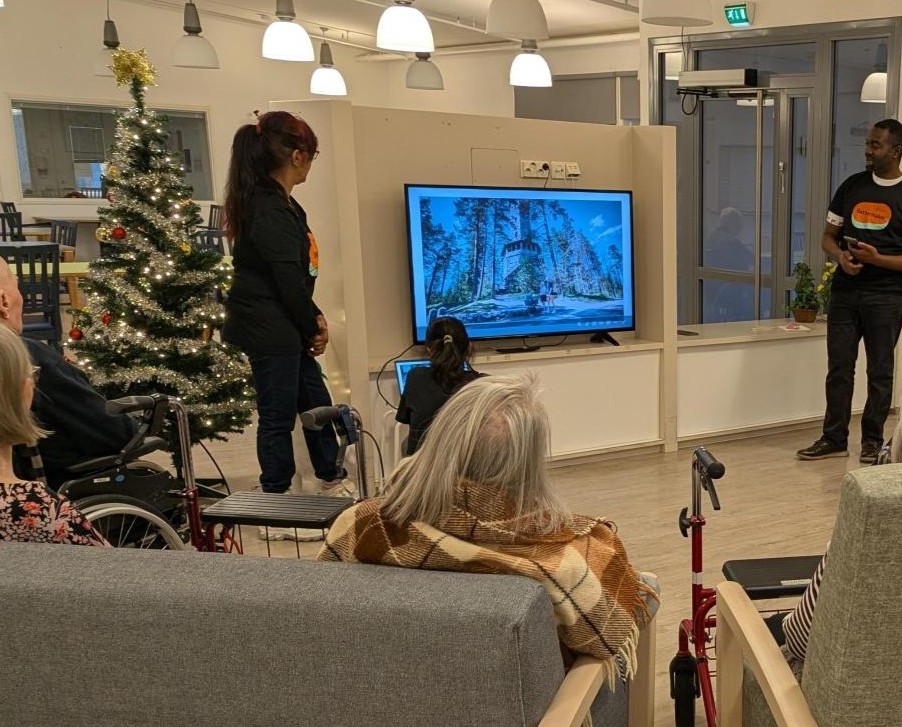
The pilot phase for the LINTU+ model was concluded over a two-day period in December 2025 at the Esperi Hoivakoti Lintumäki nursing home in Hämeenlinna. In total, 15 residents and their caregivers participated in the recreational activities. On the first day, our package included a “visual journey around Hämeenlinna,” followed by a “sensory cup activity” and finally a “silent performance.” During the visual ride in Hämeenlinna, the residents were presented with beautiful photos of iconic and popular places, including the main library, museums, railway and bus station, schools, banks, church buildings, the HAMK campus, markets and shopping malls within Hämeenlinna. We also asked short questions to help the residents recall and identify the locations (image 1).
For the sensory cup activity, we used four household ingredients: coffee, cinnamon, cardamom, and tea, each placed in small cups that are sealed but perforated with tiny holes. Each team member carried one of the cups and approached the residents individually, asking them if they could identify the smell. Finally, during the silent performance, the team members would demonstrate various actions, such as dancing, singing, laughing, exercising, running, and flying, and after each we would ask the residents if they could recognise what this action was.
On the second day, we presented activities which aimed to rekindle the beautiful memories that Christmas season brings to the residents. This included three events. The first of these was a solo instrumental performance in which our team member performed a Spanish Christmas song, and in the second activity, all team members sang one Christmas song in English. As the last activity we invited the residents and staff to join us in singing together in Finnish while a Santa Claus visited and distributed specially made Christmas gifts to the residents. Overall, the pilot phase was conducted in two days, but a week apart, so that we were able to gather experiences and make some assessments of its operations over a longer period.
How the LINTU+ model promotes the health of residents
In general, from the nursing home residents’ responses and level of collaboration that we observed, we feel that our activities managed to rekindle long-term memories for some of them. Music is known to trigger positive emotions, nostalgia, and comfort – and it naturally lowers anxiety and agitation (Drageset et al., 2023). The music further activated the residents also as it got a few of them dancing. Overall, performing together promotes a sense of achievement and pride. Most importantly, the visiting “Santa” brought them a new level of joy, laughter, comfort and surprise, in this way introducing changes to their daily life and routines at the nursing home. Santa’s visit also prompted the residents to share their Christmas wishes and memories of Christmas.
As a result of the project – based on our observations and on the reactions from both the residents and the nursing home staff – we could see that the LINTU+ model demonstrated immediate benefits in three key areas:
- Cognitive and emotional: improved memory recall, orientation, and engagement, increased positive emotions, joy, and reduced anxiety.
- Social and Relational: Enhanced sense of belonging and self-worth, stronger resident–staff relationships, increased participation and shared experiences.
- Daily Life and Facility Climate: Added meaningful variety to routines, increased cultural resonance and connection to Finnish traditions.
Overall, the benefits from this pilot show that such models for activating residents in care homes can significantly enhance both psychosocial well-being and functional engagement among older adults, including those with cognitive impairments. As we observed improvements after our activities, such as increased participation in group activities, enhanced mood, and more consistent social interaction, this suggests that structured, person-centred activation can address common challenges such as isolation, apathy, and cognitive decline in institutional care settings.
Importantly, the work carried out during this pilot demonstrated that even low-resource, routine-integrated interventions such as guided music engagement and light physical activity can produce meaningful outcomes when delivered consistently and with sensitivity to the residents’ individual needs. These findings also highlight the critical role of staff facilitation and continuity of care in sustaining engagement over time. Taken together, the results provide a strong foundation for scaling the LINTU+ model and adapting it to other care environments.
Conclusions
Based on the pilot, we think that recreational activities offer an easy and cost-effective way to promote residents’ well-being in everyday care work. Models such as our LINTU+ can offer effective, culturally adapted, and interdisciplinary frameworks that enhance quality of life in Finnish long-term care facilities. Our model’s simplicity, scalability, and grounding in Finnish cultural context make it a promising model for nationwide integration and for addressing Finland’s growing long-term care demands.
References
- Coulter, A., & Oldham, J. (2006). Person-centred care: what is it and how do we get there? Future hospital journal, 3(2), 114–116. https://doi.org/10.7861/futurehosp.3-2-114
- Dewing, J. (2008). Personhood and dementia: revisiting Tom Kitwood’s ideas. International journal of older people nursing, 3(1), 3–13. https://doi.org/10.1111/j.1748-3743.2007.00103.x
- Drageset, S., Ellingsen, S., Haugan, G., (2023). Salutogenic nursing home care: Antonovsky’s salutogenic health theory as a guide to wellbeing. Health promotion international, 38(2), daad017. https://doi.org/10.1093/heapro/daad017
- Lehtoaro, S., & Josefsson, K., Sinervo, T. (2018). Professionals’ self-rated quality of care and its relation to competence, national guidelines and policies – a cross-sectional study among Finnish elderly care workers. BMC health services research, 18(1), 896. https://doi.org/10.1186/s12913-018-3705-6
- McGrath, C., Benjamin-Thomas, T. E., Corrado, A. M., Mohler, E., Hand, C., & Rudman, D. L. (2025). Enacting the Principles of Participatory Action Research (PAR): Reflections From the Initial Stages of a Project With Older Adults With Vision Loss. International Journal of Qualitative Methods, 24. https://doi.org/10.1177/16094069251330143
- Wong, M. N., Cheung, M. K., Ng, Y. M., Yuan, H. L., Lam, B. Y., Fu, S. N., & Chan, C. C. H. (2023). International Classification of Functioning, Disability, and Health-based rehabilitation program promotes activity and participation of post-stroke patients. Frontiers in neurology, 14, 1235500. https://doi.org/10.3389/fneur.2023.1235500
- Valkama, P., & Oulasvirta, L. (2021). How Finland copes with an ageing population: adjusting structures and equalising the financial capabilities of local governments. Local Government Studies, 47(3), 429–452. https://doi.org/10.1080/03003930.2021.1877664
Authors

John Njuma Libwea
PhD, Research Fellow at the Cameroon Academy of Sciences (CAS), student at the School of Social and Health Services at Häme University of Applied Sciences

Sofia Bejarano
student, School of Social and Health Services, Häme University of Applied Sciences

Rasika Rathnayake
student, School of Social and Health Services, Häme University of Applied Sciences
Chandima Weerasinghe Jayawardena
student, School of Social and Health Services, Häme University of Applied Sciences
Janette Kiikeri
Senior Lecturer