
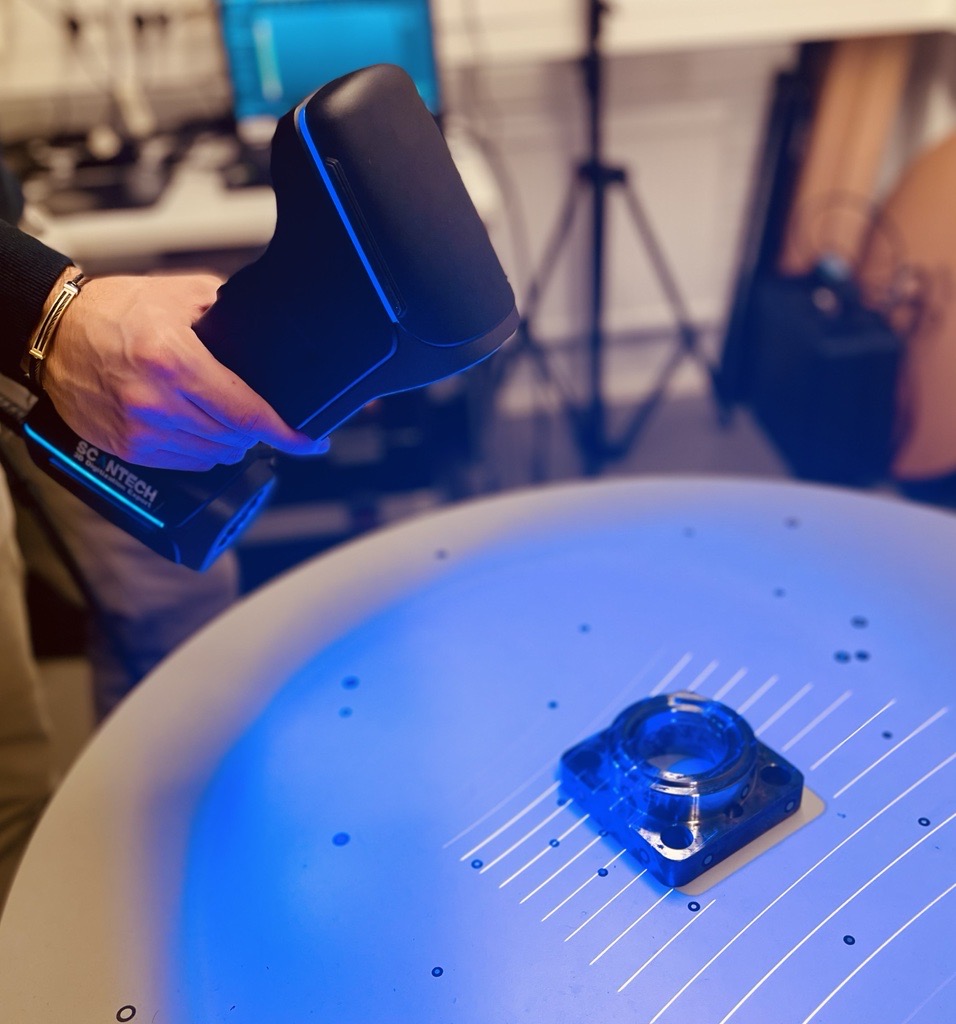
In modern engineering, 3D scanning technology is a non-contact measurement method that digitally recreates information about physical objects in a simulated environment with precise dimensions. Within Industry 4.0, which refers to digital and automated evolution of modern manufacturing, this scanning technology has become an essential tool for manufacturing, supporting applications such as design optimization, reverse engineering, and quality control (Javaid et al., 2022). Despite its increasing adoption across various industries, there are still major technical and operational issues with 3D scanning that limit the widespread implementation of the existing solutions. In industrial environments, scanners often face challenges with complex geometries and surface types, including shiny, dark, or reflective objects, and calibration errors, which can reduce data accuracy. To address these challenges, it is essential to develop high-quality 3D scanners integrated with advanced software platforms. As part of this development, artificial intelligence (AI) and machine learning (ML) are increasingly being integrated into 3D scanning systems to automate data processing, error detection, and scan refinement. These new AI-assisted 3D scanning systems do not rely only on fixed algorithms as their continuous machine learning systems learn from large datasets to identify different materials, complex shapes, and surface textures under different lighting conditions. With the help of AI algorithms, the scanning process becomes faster and more efficient, producing fully automated scan data with better surface texture quality than traditional methods.
The role of AI in 3D scanning
Artificial intelligence (AI) can significantly enhance 3D scanning process by automating data processing, improving accuracy, and adding intelligent features (Javaid et al., 2021). In several stages of the 3D scanning process, such as capturing, aligning, cleaning, and interpretation, an AI algorithm can be employed to make the process faster, more reliable, and less labour-intensive. Because of this, AI-based algorithms play an important role in transforming raw data into high-quality, usable 3D models. In this type of application, AI processes the scanned raw data to create a point cloud, which represents the surface of the scanned object. Software algorithms then convert this point cloud into a 3D mesh. After this, the AI-driven alignment system automatically identifies matching features between scans and positions them correctly, merging all data into one complete and accurate 3D model. Traditionally, post-processing steps have required human intervention to manually identify and align coordinate systems with the CAD (Computer-Aided Design) model that is being created. In contrast, AI-based machine learning algorithms are trained to detect both standard geometric elements (such as holes, edges, steps, angles, and bolts) and complex free-form surfaces directly from raw scanned data. After this identification, the AI-based algorithms can then instantly align the scanned data with the created CAD model. Since AI-based algorithms identify shiny or reflective surfaces by recognizing patterns of reflection noise, AI can also improve accuracy by filtering out noise from the data. Furthermore, AI-based software offers real-time feedback during the scanning process, allowing users to make necessary adjustments such as modifying scanning parameters, correcting scanning path, and repositioning the object or scanner to ensure complete and high-quality scan data. Mesh repair is another key feature, enabling the software to fill holes, smooth surfaces, and correct imperfections in the 3D model.
How AI works in 3D scanning
AI uses algorithms that can improve data capture, processing, post-processing, and analysis, making the process more accurate, faster and more efficient. Most of the current AI-based 3D scanning technologies are point-cloud based. Essentially, a point cloud consists of millions of 3D points on an object’s surface. Unlike 2D images, the points are unordered and thus traditional image-based neural networks, which are designed to process structured grid-like data, cannot take such inputs directly.
There are several AI-assisted tools to help create these types of point-cloud based models. For example, researchers have proposed dedicated models such as PointNet, which learns to classify and segment points without considering their order, and PointNet++, which develops advanced features such as understanding local geometric features that help capture curved or fine surfaces. Another advanced AI algorithm model used for this purpose is the Dynamic Graph Convolutional Neural Network (DGCNN), which has the capability to relate points to one another by connecting each point to its adjacent points (Wang et al., 2019). This approach can automatically align scan data with the CAD model by recognizing real object edges (Bahreini & Hammad, 2024). AI can then help to clean noisy scans through tools like PointCleanNet which is a machine-learning approach trained to remove noise and outliers from point-cloud data (Rakotosaona et al., 2020). Another model that can be useful for this purpose is the autonomous AI-based Simultaneous Localization and Mapping (SLAM) model that uses sensors to build a map of an unknown environment while simultaneously detecting its own position within the map (Alsadik & Karam, 2021). This model helps handheld scanners to map their environment in real time while tracking movement. Unlike traditional geometry-based SLAM models, AI-based SLAM systems can identify 3D features and realize when the scanner is recapturing a place (that is, they function as loop closing systems). In addition, neural models like PointNetVLAD help to create descriptors for place recognition to overcome mapping stability issues, even in challenging (repetitive or complex) environments (Uy & Lee, 2018).
AI in commercial 3D scanners
AI-based algorithms already exist in some commercial scanners. For example, the Artec Leo is a handheld structured light scanner which contains an onboard NVIDIA Jetson TX2 processor (Artec Leo, 2025). It employs AI to keep track of objects in real time, filter noisy data and retain accuracy even at high speed in order to select high-quality, valid points to incorporated into the live 3D model. Similarly, the Creaform HandySCAN BLACK Series utilizes blue laser triangulation and AI-based segmentation to differentiate between actual object edges from reflection and scanning noise edges. Its automatic surface cleaning feature follows DGCNN-like models in that it can also detect bad laser points and reject them before meshing. Another example of a similar approach is the Leica BLKGO which uses LiDAR and panoramic cameras for real-time mapping and relies on deep-learning algorithms to detect and ignore moving objects (Leica-geosystems, 2025). During post-processing, this scanner will also classify surfaces such as walls, doors, and ceilings. This type of an AI-based algorithm ensures stable SLAM tracking and cleaner semantically labelled 3D models. For construction and forensics, on the other hand, the FARO Freestyle 2 handheld scanner uses AI to recognize planar surfaces such as floors and walls while scanning (Faro, 2025). This is useful for minimizing misalignment and enhancing scanning precision by leading the user in real time. Even less expensive, smaller scanners like the Shining 3D EinScan HX and Revopoint POP feature AI-based cleaning and alignment (Shining3d, 2025). These systems use machine learning algorithms, which help to automatically align scans, noise cleaning and interpolate missing areas. They often also use light-weight models inspired by PointCleanNet that are commonly utilized for accelerating and enhancing post-processing.
At Häme University of Applied Sciences, these AI-assisted 3D scanning technologies have been evaluated in the KOHU – Kohti toimivaa kiertotaloutta ja huoltovarmuutta (“Towards a functioning circular economy and security of supply”) project. This project aims to strengthen the security of supply and circular economy in Finland’s local mechanical and metal industry by supporting sustainable manufacturing practices and local production of spare parts. In such use, AI-assisted 3D scanning enables the precise digitization of damaged and worn components, allowing them to be repaired through additive manufacturing and thereby extending their operational lifespan (Jadhav et al., 2019). Alternatively, components can be accurately remanufactured using additive manufacturing (AM) methods that enable agile and localized spare part production (Javaid et al, 2021). When AI-based algorithms are applied to clean and repair raw scan data, the 3D model can be made ready for immediate use in 3D printing, which can in turn speed up the repair cycle and reduce material waste. In addition to its technical benefits, AI-assisted 3D-scanning technology also offers educational and organizational value. This is because it promotes collaboration between engineers, designers, and students who can use this to learn about the relationship between digital design and physical production.
Discussion: Industry challenges and the AI advantage
Although artificial intelligence has made remarkable changes in the field of 3D scanning technology by improving overall scanning quality, accuracy, and usability, there still remain several limitations that need be addressed before AI-based 3D scanning systems can be fully implemented in the industrial sector. One of the most significant issues is traceability and explainability. It is not enough to produce accurate scan data, as this data should also be transparent and interpretable so that results can be verified according to metrological standards. To enable this, current industrial practices are often combined with the traditional geometric validation method and AI-driven segmentation, so that the final measurements remain traceable to recognized metrological standards. Another major challenge is model generation. AI-based 3D scanning software is a machine learning process that is trained by specific datasets. Because of this, it may not perform equally well in different cases, for example, under different lightening conditions, or with different conditions in terms of surface texture or geometry. Overall, it is clear that large and diverse datasets are required to create precise machine learning algorithms.
From a business and operational perspective, the integration of AI in the field of 3D scanning technology provides significant production advantages. Modern 3D scanners can automatically filter noise, align data, fill holes, and correct discontinuities to generate complete and reliable scan information (Javaid et al., 2021). Real-time adaptive scanning is another feature that can improve the overall scanning processes. An AI-based 3D scanner can automatically and in real time adjust scanning parameters such as exposure, laser intensity, and measuring objects in response to changing factory conditions. For example, the HandySCAN BLACK series of scanners utilize advanced AI-based software that can create real-time water-tight mesh by automatically cleaning noisy data. This makes the entire post-processing step faster and more automated. Additionally, these devices have advanced machine learning algorithms that can detect reflective surface geometry without any surface preparation. Similarly, The Artec Studio scanners have AI-based features that can scan objects without any targets. As scanning data is being integrated into digital twin systems and Industry 4.0 applications, artificial intelligence-based inspection is becoming more advanced (Muminović et al., 2023). As a result, these types of AI-based functions are developing from basic quality control into an intelligent method that predicts tool wear, prevents defects and significantly increases overall production productivity in the long run. Overall, while industrial AI integration faces challenges related to data generalization, explainability, and human adoption, its benefits in precision, efficiency, and consistency are clear. With ongoing advances in adaptive deep learning and edge computing, AI-enhanced 3D scanning is a crucial step towards fully autonomous, intelligent inspection systems.
References
- Alsadik, B., & Karam, S. (2021). The Simultaneous Localization and Mapping (SLAM)-An Overview. Journal of Applied Science and Technology Trends, 1202-131. Retrieved from http://doi.org/10.38094/jastt204117
- Artec Leo. (2025). Artec Leo. Retrieved 2025, from https://www.artec3d.com
- Bahreini, F., & Hammad, A. (2024). Dynamic graph CNN based semantic segmentation of concrete defects and as-inspected modeling. Automation in Construction, 159. Retrieved from https://doi.org/10.1016/j.autcon.2024.105282
- Faro. (2025). Retrieved from https://knowledge.faro.com
- Jadhav, M., Durgude, Y., & Umaje, V. N. (2019). Design and development for generation of real object virtual 3D model using laser scanning technology. International Journal of Intelligent Machines and Robotics, 273-291. Retrieved from https://doi.org/10.1504/IJIMR.2019.101770
- Javaid, M., Haleem, A., Singh, R., & Suman, R. (2021). Industrial perspectives of 3D scanning: Features, roles and it’s analytical applications. Sensors International, 2. Retrieved from https://doi.org/10.1016/j.sintl.2021.100114
- Javaid, Mohd & Haleem, Abid & Singh, Ravi & Suman, Rajiv & Santibanez Gonzalez, Ernesto. (2022). Understanding the adoption of Industry 4.0 technologies in improving environmental sustainability. Sustainable Operations and Computers. 3. https://doi.org/10.1016/j.susoc.2022.01.008
- Leica-geosystems. (2025). Retrieved 2025, from https://leica-geosystems.com/
- Muminović, A., Smajić, J., Šarić, I., & Pervan, N. (2023). 3D Scanning in Industry 4.0. Proceedings of the International Scientific Conference: Basic Techologies and Models for Implementation of Industry 4.0. Retrieved from http://doi.org/10.5644/PI2023.209.10
- Rakotosaona, M.-J., La Barbera,, V., Guerrero, P., J. Mitra, N., & Ovsjanikov, M. (2020). PointCleanNet: Learning to Denoise and Remove Outliers from Dense Point Clouds. COMPUTER GRAPHICS forum, 39, 185-203. https://doi.org/10.48550/arXiv.1901.01060
- Shining3d. (2025). Retrieved from https://www.shining3d.com/
- Uy, M. A., & Lee, G. (2018). PointNetVLAD: Deep Point Cloud Based Retrieval for Large-Scale PlaceRecognition. 2018 IEEE/CVF Conference on Computer Vision and Pattern Recognition, Retrieved from http://doi.org/10.1109/CVPR.2018.00470
- Wang, Y., Sun, Y., Liu, Z., Sarma, S., Bronstein, M., & Solomon, J. (2019). Dynamic Graph CNN for Learning on Point Clouds. ACM Transactions on Graphics (TOG), 38(5), 1-12. Retrieved from http://doi.org/10.1145/3326362
Authors

About the project
The text was written as part of the KOHU project-Kohti toimivaa kiertotaloutta ja huoltovarmuutta (“Towards a functioning circular economy and security of supply”), funded by Hämeen Liitto regional council of Häme and co-funded by the European Union.