Building research skills and clarifying career goals in work trial
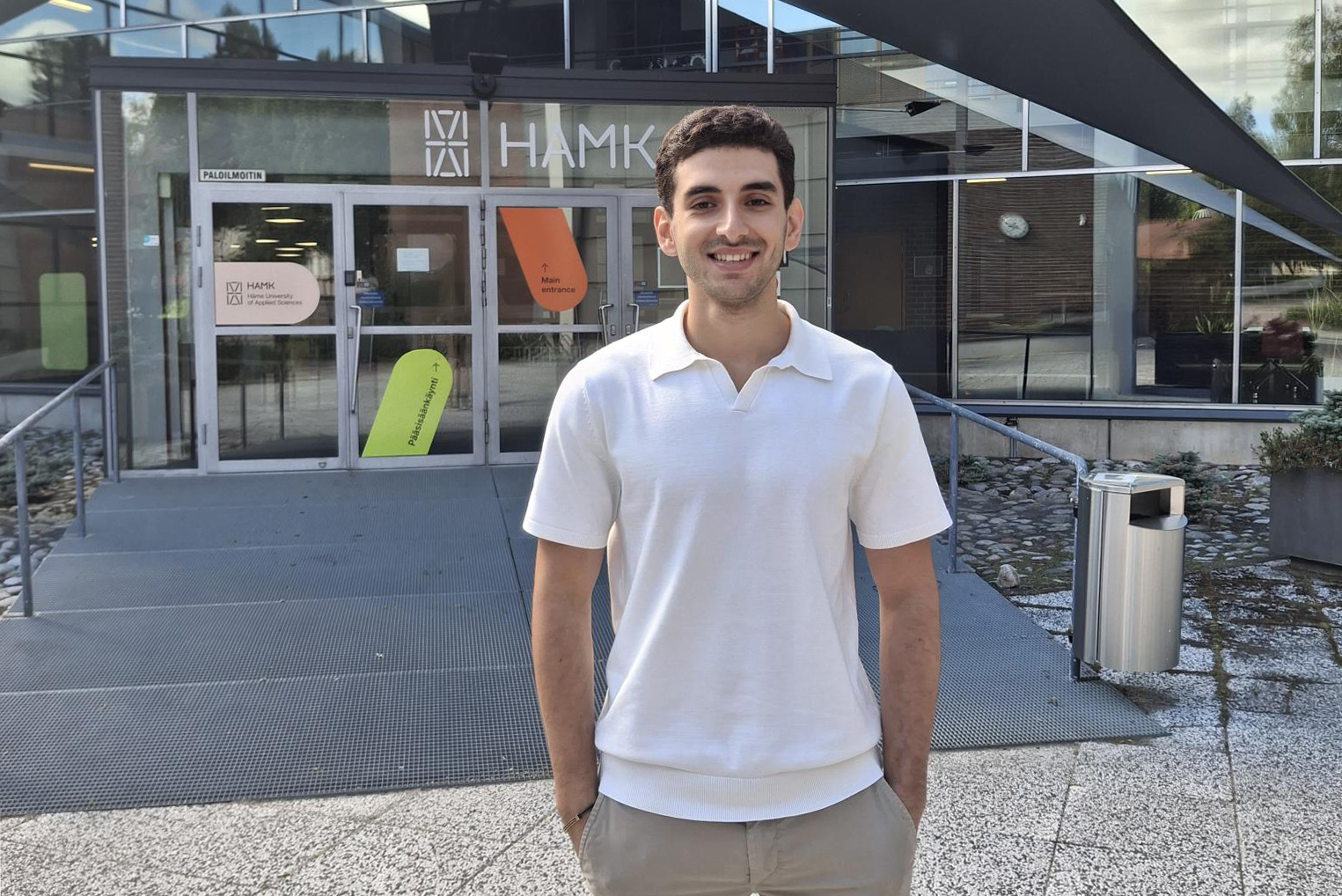
HAMK graduate Jad Eid deepened his expertise in additive manufacturing during a work trial in the KIERTO-AM project in summer 2025. The work trial combined research skills, technical design, and perspectives on sustainable manufacturing.
Additive manufacturing, more commonly known as 3D printing, is a relatively new production technology. Its main advantages are the ability to print structures that are more complex than those produced with traditional methods and targeted use of material only in areas where it is needed. The technology also enables efficient use of materials and energy, which makes it a more environmentally sustainable manufacturing alternative.
Additive manufacturing raises interest in students and recent graduates as well. This is why Jad Eid, graduate from HAMK’s Mechanical Engineering and Production Technology programme, ended up doing a work trial in the project Circular economy advancing additive manufacturing (KIERTO-AM).
The aim of KIERTO-AM project is especially to promote the adoption of still relatively unknown binder jetting technology within manufacturing industries in Finland. Jad is particularly fascinated by the future potential and efficiency of additive manufacturing, and by the opportunities it opens for more sustainable production. He is also drawn to the freedom technology offers in designing increasingly complex parts.
A versatile dive into different technologies
Jad’s work trial took place during summer 2025. Originally, he was supposed to focus on a technical comparison of printing processes, specifically on the properties of parts produced with different printing technologies. In practice, however, the work focused more on analysing literature related to binder jetting and laser powder bed fusion. He also had the opportunity for more hands-on work when he designed model versions of the parts that could later be used in testing..
“The theoretical nature of the tasks was a bit surprising, but I am still happy with the work trial as a whole,” Jad sums up.
The literature analysis increased his knowledge of both technologies, although he noticed that significantly less literature was available regarding the design aspects of binder jetting.
For Jad, the best part of the work trial was designing the test parts, as it allowed him to combine creativity with technical expertise. He was also motivated by the fact that the results of his literature analysis could be used to develop guidelines for the project on the applications binder jetting and laser powder bed fusion perform best.
Research environment opened new ways of thinking
While working in the research group, Jad observed that the emphasis was placed not on the final outcome, but on the process itself and on gaining an in-depth understanding of the topic. Discussions with the team were often open-ended, which encouraged critical thinking and the exploration of new perspectives. There was room for creativity and consideration of different options, and it was rewarding to learn about new technologies and the latest developments in the field.
During the internship, Jad was able to develop his design skills and refine his research skills, which increased his confidence in working within a research environment. He found teamwork rewarding and appreciated the support that was always available. Jad describes that the work trial helped clarify his career plans, and additive manufacturing will likely remain part of them in the future.
In the autumn, Jad continued his studies in Aalto University’s Master’s Programme in Mechanical Engineering and began working as a research assistant in another HAMK additive manufacturing project, Towards a functioning circular economy and security of supply (KOHU). In the KIERTO-AM project, we are preparing to introduce a new binder jetting printer in an open, low-threshold testing environment for companies at HAMK’s Riihimäki campus. The project also explores new side-stream and bio-based printing materials that support the circular economy.
Circular economy advancing additive manufacturing (KIERTO-AM)
In the Circular Economy–Driven Additive Manufacturing (KIERTO-AM) project, we aim to promote the adoption of binder jetting technology – still relatively little known in Finland – within the manufacturing industry. In addition, the project explores new side-stream and bio-based printing materials that support the circular economy.
The project is implemented in collaboration with LUT University..
The project is co-funded by the European Union.