Rethinking steel construction: towards reusable and weld-free structures
As the construction industry looks for more sustainable and adaptable solutions, traditional methods are being re-evaluated. In the steel construction sector, researchers are now developing new ways to make steel structures easier to assemble, disassemble, and reuse. One area of focus is mechanically fastened joints and how their performance can be improved using advanced laser-based techniques.
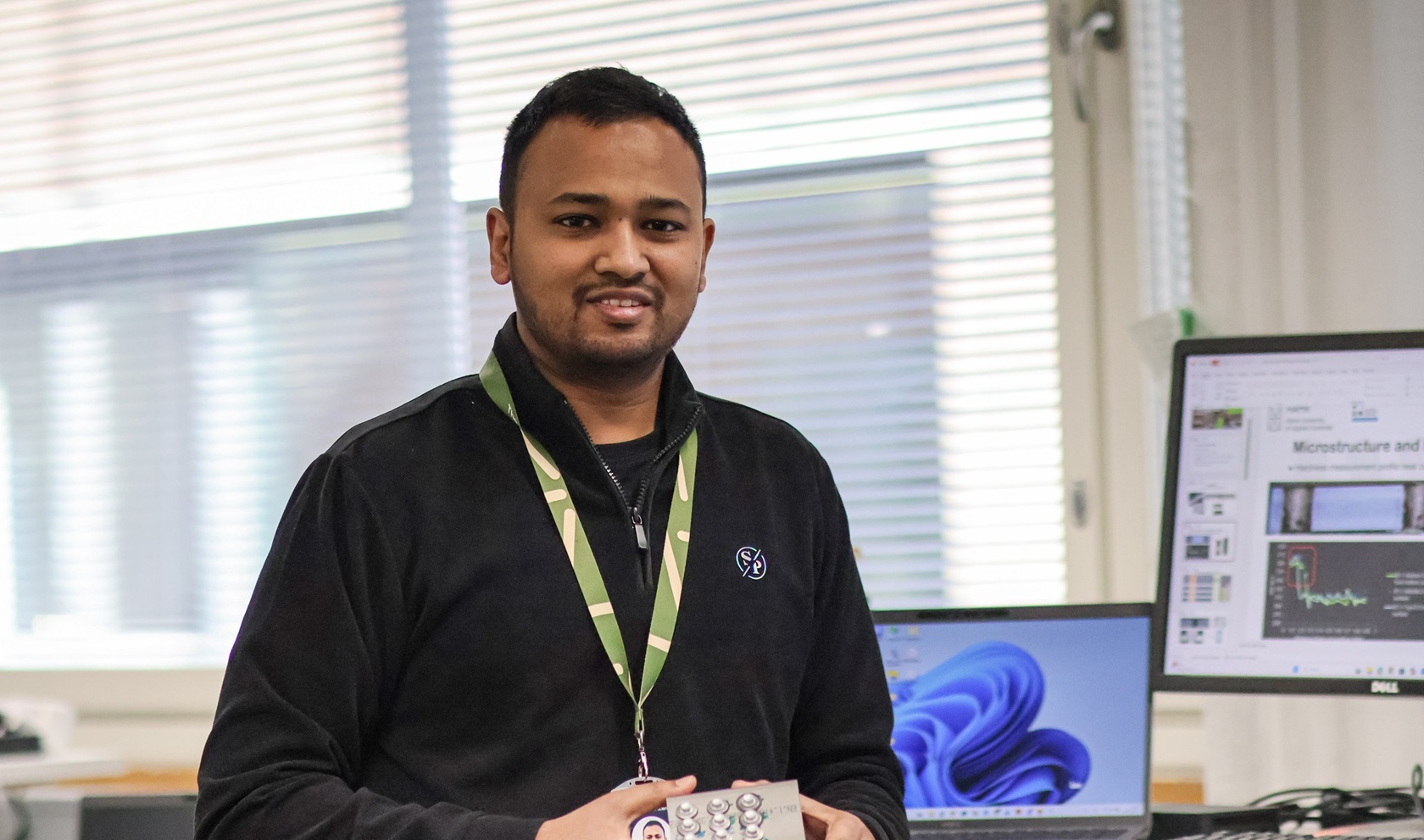
Mizanur Rahman works as a research engineer in HAMK Tech research unit. His current research focuses on a fundamental challenge in steel construction: how to make weld-free mechanical joints. He studies laser-based softening to reduce material hardness and drillability of different fasteners as a practical solution to enable effective installation and performance of mechanically fastened joints.
From aeronautical engineering to the world of applied research
Mizanur’s background is in aeronautical engineering. He completed his bachelor’s degree in Bangladesh and then worked in the industry as a structural engineer before moving to Finland to continue his master’s studies at LUT University.
“During that time, I was suggested by a future HAMK-colleague, lecturer Blerand Greiçevci, that I could do my master’s thesis in Häme University of Applied Sciences’ HAMK Tech research unit. After successfully completing my thesis, I joined HAMK as a research engineer one year later”, Mizanur reminisces.
Since then, his work has focused mainly on high-strength steel welding and experimental studies on structural steels. Now through his doctoral studies, he’s continuing along the same direction.
“My PhD work is connected to the MechJoint project, which is funded by Business Finland, where we are developing mechanical joint solutions for steel structures. My research focuses particularly on laser-based softening and drillability.”
Closing the gap between research and practice
Sustainability and material circularity are central to Mizanur’s work. Construction consumes large amounts of materials and energy, and although steel is already a recyclable material, even greater benefits could be achieved if steel components could be reused as such, without melting them down. Welded structures are difficult to dismantle without damage, but mechanical joints offer a new, more practical way to assemble, repair, and disassemble structures.
“For me, circularity means designing structures not just for a single use, but with future reuse in mind”, Mizanur states.
Many good solutions for the construction sector already exist in research, but they are not always easily applicable in companies’ real projects. Bridging this gap requires close cooperation with companies, testing new solutions in practice, and presenting the results in a way that they are easy to understand and use.
HAMK is an ideal place to conduct research because it supports applied work that can lead directly to practical solutions.
This is also where, to Mizanur, HAMK stands out as a research environment, as the research is practical, closely connected to real industrial needs and more application-oriented rather than purely theoretical.
“HAMK is an ideal place to conduct research because it supports applied work that can lead directly to practical solutions.”
Towards more flexible and efficient steel construction
In the long term, Mizanur hopes that his research will help the steel construction industry adopt mechanically fastened joints with greater confidence. From an industry perspective, utilizing the new methods could simplify manufacturing, speed up assembly, improve logistics, and make repair and reuse of steel components more practical.
His work contributes to bettermaking by developing practical, research-based solutions for steel construction. By focusing on laser-based softening, drillability, and mechanical joints, Mizanur aims to support the development of steel structures that are strong, reliable, and easier to reuse.
“Bettermaking means turning scientific research into solutions that contribute to a more sustainable and circular construction sector.”