The next generation entering working life will play a decisive role in addressing global sustainability challenges. Preparing young people for this reality requires learning environments that go beyond the transmission of knowledge and instead support the development of confidence, curiosity, and the ability to navigate uncertainty.
In April 2026, HAMK Future Innovators Labs (FILS) delivered a week-long programme for a group of 19 high school students from three schools, two from Hämeenlinna, Finland, and one from Limerick, Ireland. The students voluntarily participated in the programme, stepping into an unfamiliar learning environment that brought together multicultural teamwork, challenge-based learning, and hands-on activities.
This article examines how the week was structured, what emerged through the learning process, and what the experience revealed about experiential, student-centred learning beyond the comfort zone. It reflects on how intentionally designed moments of discomfort, when supported through facilitation and structure, can act as a catalyst for learning and personal growth.
Designing 21st-century skills
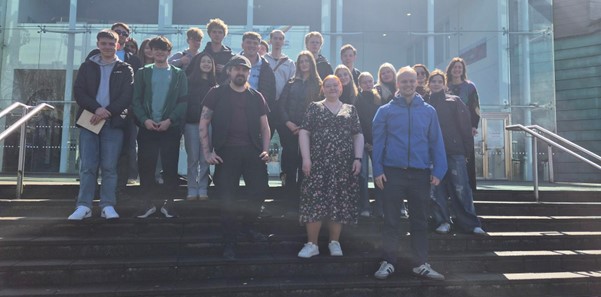
HAMK Future Innovators Labs (FILS) offers short, practice-oriented learning experiences that complement traditional education by focusing on applied, experience-based skill development. The aim of this programme was to provide a tailored learning experience to high school students and their educators that would introduce ways of learning that are often less visible in conventional classroom settings. The project was hosted in Limerick (Image 1).
The week focused on building future-ready skills through challenge-based learning. This was implemented through hands-on activities carried out in multicultural student teams, where participants were encouraged to actively test ideas rather than rely on predefined answers. Particular emphasis was placed on developing solutions through user understanding and feedback, introducing students to ways of working that prioritise real-world relevance.
As a central challenge, students were tasked with designing an interactive educational booth on sustainability themes, meaning a concept or prototype of a space that engages users through activities, visuals, or participation rather than passive information delivery. Rather than starting from fixed instructions, the challenge was developed in collaboration with the students, allowing their interests to shape the direction of the work while also responding to the expectations of the participating educators.
This pedagogical approach is not new. For decades, researchers and educators have highlighted that traditional schooling, while valuable, often underinvests in what are commonly referred to as 21st-century skills: critical thinking, communication, collaboration, and creativity (Trilling & Fadel, 2009). However, the need to strengthen these capabilities has become increasingly urgent as societal challenges grow more complex and interconnected.
Design thinking offers one approach to addressing this gap. Grounded in empathy, iteration, and testing ideas against real-world feedback, it provides practical tools for navigating complex, open-ended problems (Brown, 2009). In the FILS programme, design thinking was not treated as an additional method, but rather as the guiding logic of the entire week, shaping how students approached both learning and problem-solving.
Programme of the week
The week was designed as more than a single programme; it was a carefully structured learning journey. This type of programme differs from typical classroom learning by introducing design thinking approaches already at the high school level. From the first moments on Monday to the final presentations on Friday, each day intentionally built on the previous one. Students were guided from initial hesitation to growing confidence, from assumptions to evidence-based ideas, and from silence to active participation. Bringing together nineteen teenagers from different schools and cultural backgrounds challenged them not only to collaborate, but also to step outside their comfort zones, question their thinking, and find their voice. The facilitation team remained consistent throughout the week and consisted of two HAMK staff members responsible for teaching, two guidance counsellors from Hämeenlinna high schools, two staff members from the Technological University of the Shannon (TUS) supporting logistics, and three Crescent College staff members who participated in supervision on a rotating basis. The following section reflects on this journey, day by day.
Monday – Setting the tone
The week began with introductions to the facilitation team, the programme, and the mindset guiding the week, which was built around three simple principles: be curious, be brave, ask questions. As expected, students arrived cautious and reserved, as nineteen teenagers often do when mingled with other students from three unfamiliar schools. All activities throughout the week were intentional and designed to build skills the students will need in working life, including confidence, pitching, working across cultures, and stepping beyond their comfort zones. Monday focused on icebreakers with activities like Two Truths and a Dream, which encouraged students to speak in front of others within the first hours of the programme.
Despite visible discomfort, every student stood up, paired with someone they had just met, and read their cards aloud. For the Irish counsellors accompanying the group, this was something they said they would not have believed possible from their students. Yet it happened. In that moment, sharing, vulnerability, and showing up for the group became lived experiences rather than abstract expectations. The conversations that emerged also offered facilitators early insight into the students’ behaviour, communication styles, and perspectives beyond their usual school roles. The day continued with a campus tour, the official launch of the challenge, and the first working session in newly formed multicultural teams.
Tuesday – Questioning, thinking, pitching
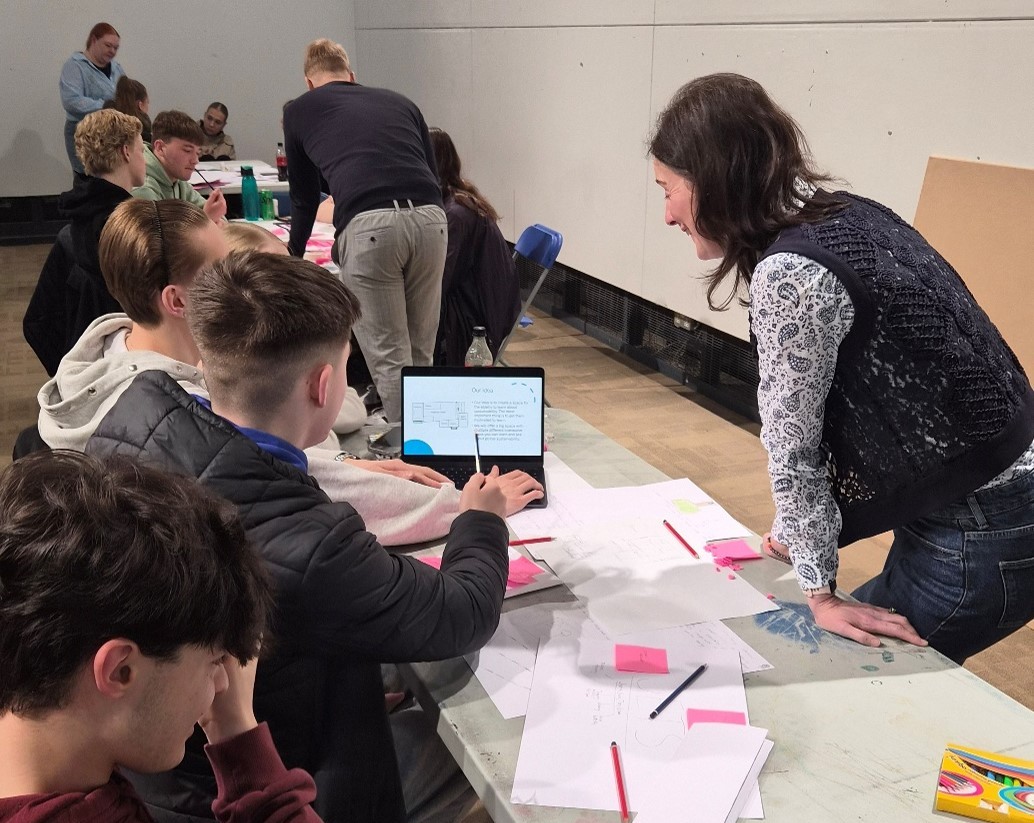
Tuesday was an intensive day of design thinking and service design workshops, moving the students from the energy of Monday’s introductions into the more demanding work of solving something. The shift was noticeable when students began questioning themselves and their ideas students began questioning their ideas, assumptions, and ways of thinking through open discussion and reflection (Image 2), which, rather than being seen as a setback, was exactly the point. Learning to sit with uncertainty and challenge one’s own assumptions was one of the most valuable skills the week had to offer.
The day opened with user understanding, helping students identify who they were designing for, so their solutions would be grounded in real needs rather than guesswork. From there, they moved on to mapping their initial assumptions and observations, a phase that pushed them to articulate what they thought they knew and where the gaps were. These two steps then fed directly into a first round of solution development for their interactive educational booth concepts, now shaped around a specific audience rather than a general idea. Every activity was designed to stretch the students in ways that would serve them beyond the week activities and assignments. Every activity was designed to stretch the students in ways that would serve them beyond the week itself.
The focus was placed on building the habit of questioning, following the data, reframing, ideating, and iterating. We wrapped up the day with a practical introduction to interviewing and pitching skills, including an honest conversation about the fact that feeling nervous before speaking to an audience is universal, but what is important is learning from the experience, observing, and a willingness to step outside of one’s comfort zone.
Wednesday – Testing assumptions in the real world
On Wednesday, learning moved outside the classroom. Students were given an assignment to carry into their cultural excursion in Limerick: gathering real feedback on their emerging ideas from their defined user groups. The task combined cultural exploration with one of the most critical stages of any design process, testing assumptions against real-world feedback.
Approaching strangers proved challenging for many students, particularly for those to whom Limerick is an unfamiliar city. Nevertheless, students adapted and conducted interviews throughout the day. While the depth and quality of collected feedback varied between teams, the variation itself became instructive. Some teams demonstrated an ability to interpret not only spoken responses but also non-verbal cues. Even when feedback remained at surface-level, observant teams used what they gathered to meaningfully refine their concepts. The cultural context added an additional layer of learning, requiring adaptability and openness to unfamiliar social environments.
Thursday – From assumptions to facts
The day opened with a pitching energiser, where students introduced a fellow student to the audience. Though not a pitch on their project, because the exercise was never just about introductions. Although this was not a project pitch, the exercise went beyond simple introductions. It was about standing up, framing someone else’s story, and delivering it with confidence. This was another deliberate step in building their pitching skills they would need by the end of the week.
Otherwise, Thursday marked a turning point for the week, where some interviews from the previous assignment were processed to allow the teams to ground themselves in real data before moving forward. At this point it became apparent that something shifted because the students began to realise that the feedback they had gathered was a valuable tool. The feedback data gave them permission to make confident decisions by moving away from guesswork and toward genuine solutions based on real user feedback. This realisation allowed students the confidence to shape their ideas based on what they had learned, which was one of the clearest moments of growth across the week (Image 3).
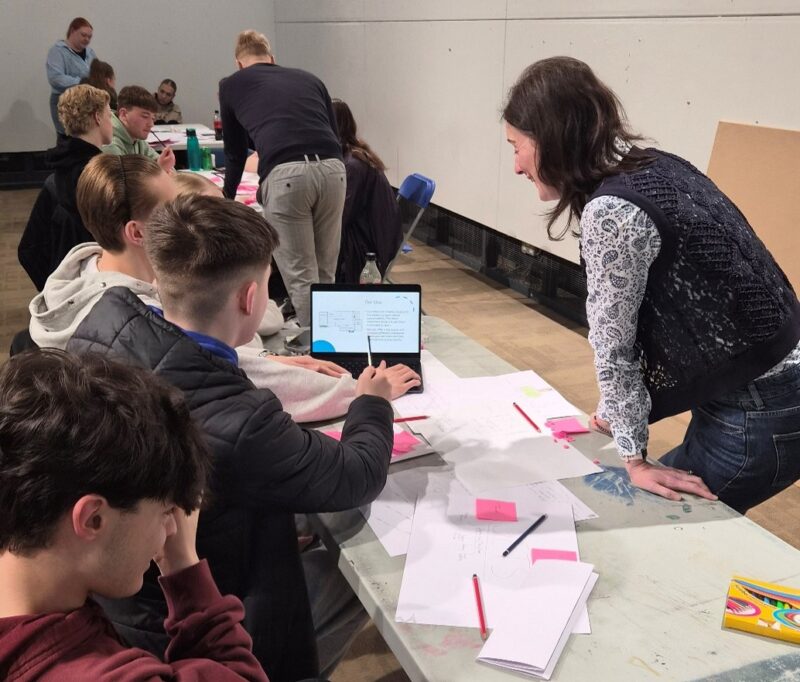
In essence, the workshop lectures focused on re-developing solution ideas in greater detail, building on the factual foundation the students had constructed. This phase asked students to critically examine the gap between what they had assumed at the start of the week and what the evidence was now telling them. For Finnish students, Thursday also included a visit to the Moylish campus of TUS, offering insight into a different educational environment beyond the programme itself.
Friday – Showing up and speaking out
Friday brought the week full circle. The day began with a paired exercise in which students pitched their team’s concept to one another, echoing Monday’s icebreakers but now informed by a week of growth. This was followed by a keynote on information design and an introduction to Canva, an online graphic design tool, equipping students with practical tools for visual communication.
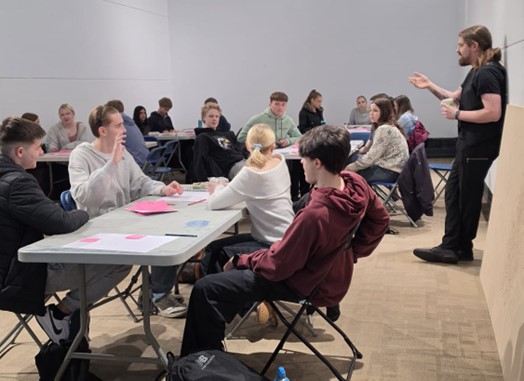
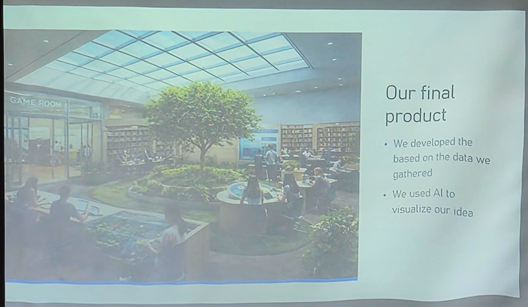
The final presentations saw teams pitch their interactive educational booth concepts (Image 4) to a panel of four external judges representing education and research. What stood out was not the technical sophistication of the ideas, but the fact that every student contributed verbally. Many students spoke without notes and even a group that had struggled to make eye contact on Monday now presented confidently to an unfamiliar audience. The week concluded with certificates and words of encouragement, acknowledging both what students had created and who they had become through the process.
Student feedback and learning outcomes
At the end of the programme, we gathered feedback from all 19 participating students through a survey focusing on their learning experiences in the lectures and workshops. The responses strongly reinforced the progression observed throughout the week, highlighting a shift from initial uncertainty toward increased engagement, confidence, and personal growth.
Overall ratings of the programme activities were clearly positive. Most students rated the workshops and lectures highly: On a scale of 1 to 5, most students rated the learning week at 4 (12 students) and 5 (4 students). In their feedback, students frequently pointed to the interactive and practical nature of the learning environment as a key strength. This aligns closely with the core intention of the FILS programme: to prioritise active participation over passive learning and to anchor solution development in empathy-driven processes, particularly during the user understanding and interviewing stages rather than predefined answers.
A recurring theme in the responses concerned stepping outside personal comfort zones. Activities such as pitching, interviewing, learning by doing, and collaborating within unfamiliar multicultural teams were often described as challenging at first, yet ultimately rewarding. These experiences mirror the learning trajectory observed during the week, where discomfort was not avoided but intentionally designed as part of the learning process. When supported through facilitation and structure, this discomfort appeared to translate into increased confidence and skill development This pattern reflects what Kapur (2016) describes as “productive failure” (p. 289), where carefully scaffolded difficulty accelerates learning rather than impeding it.
In addition to overall satisfaction, students highlighted the value of real-world relevance in the tasks. The emphasis on gathering user feedback, reflecting on assumptions, and iterating based on evidence was repeatedly mentioned as meaningful. This feedback directly supports the observed turning point midweek, when students began to treat feedback not as criticism but as a tool for improving their ideas and making more confident decisions.
At the same time, the survey also offered constructive suggestions for development. Several students expressed a desire for more informal time to connect with peers, fewer icebreakers, or more balanced pacing between sessions and breaks. These comments suggest that while the intensity of the programme supported learning outcomes, minor adjustments could further strengthen the social and reflective dimensions of the experience.
Taken together, the student feedback on the programme indicates that it successfully achieved its core aims of building confidence, encouraging curiosity, and developing key skills such as communication, collaboration, and critical thinking. Most importantly, the feedback confirms what was visible throughout the week: students did not merely participate in the programme but grew through it.
Conclusion
The FILS programme demonstrated the effectiveness of experiential, student-centred learning in developing future-ready skills among high school students from different schools and countries. Through intentionally structured progression, students moved from hesitation to confidence, engaging in multicultural collaboration, problem solving, and sustainability-focused innovation. Observations and feedback confirm that this transformation was not accidental but the result of a purposefully designed programme.
A key finding from the week concerned the role of discomfort in learning. Activities such as interviewing, pitching, and collaborating with unfamiliar peers consistently emerged as both the most challenging and most impactful experiences. Students also demonstrated a shift from assumption-based thinking toward evidence-based decision making, recognising the value of feedback and iteration. Viewed through the lens of 21st -century skills development, the week functioned as a microcosm of real-world learning conditions. While minor adjustments to the programme remain necessary, the experience confirms the value of human-centred, hands-on learning in preparing young people for complex global challenges.
References
- HAMK. (2024). RUN-EU and HAMK’s Design Factory put effort into the future skills of children and young people. https://www.hamk.fi/en/run-eu-and-hamks-design-factory-put-effort-into-the-future-skills-of-children-and-young-people/
- Brown, T. (2009). Change by Design: How Design Thinking Transforms Organizations and Inspires Innovation. HarperCollins Publishers.
- Kapur, M. (2016). Examining Productive Failure, Productive Success, Unproductive Failure, and Unproductive Success in Learning. Educational psychologist, 51(2), 289–299. https://doi.org/10.1080/00461520.2016.1155457
- Trilling, B., & Fadel, C. (2009). 21st century skills: Learning for life in our times. Wiley.
Authors