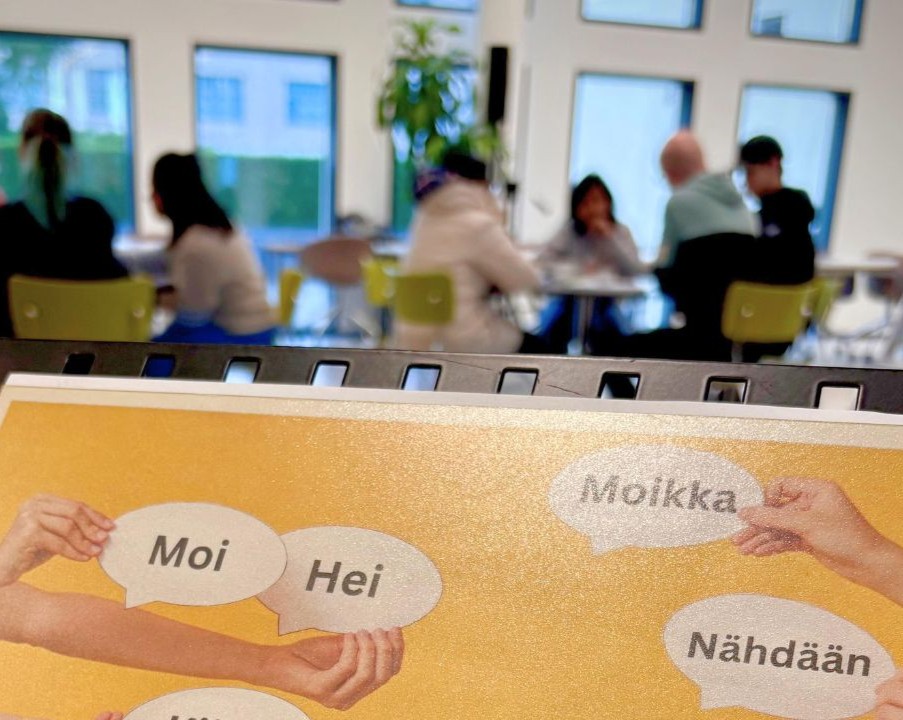
In recent years, Finland has become a study destination for international students. Moving to Finland means getting to know a new way of living and learning the Finnish language. Learning Finnish is not only about learning words and grammar but also about using the language in everyday situations that can help students to understand the culture around them, to communicate with others, and to make new connections.
Since the beginning of 2026, all students at the Häme University of Applied Sciences (HAMK) have been provided the opportunity to join weekly language cafés on six out of seven HAMK campuses. The concept of language cafés was first introduced at HAMK in the spring of 2023 when it was organized by HAMK Career Services. Today, the language cafés are facilitated in co-operation between the Moment – Influential Career Guidance and Strengthening Vibes project, HAMK Career Services and regional partners in Valkeakoski and Hämeenlinna.
The Moment project supports the integration, employment, and well-being of international degree students, their spouses and alumni in the Kanta-Häme region. One of the project’s main objectives is to strengthen the students’ Finnish language skills and support their attachment to the region (HAMK, n.d.). Community counsellors and the Finnish language career counsellor from The Moment project actively listen and identify the needs of the students. One of these identified needs was the wish to practice Finnish outside the classroom. As a result, more language cafés were established on HAMK campuses. Language café is a place where the participants get a chance to talk in Finnish. Everyone, no matter their language skills or their mother tongue, is welcome to join (Kielibuusti, n.d.).
Language cafés are open to everyone, and also Finnish students, in addition to the international students, can benefit from participating in their activities. The Kielifrendi (“language friend”) concept was piloted in some of HAMK’s campuses during spring 2026, giving also the Finnish students the opportunity to support international students as a Kielifrendi volunteer. A person who acts as a Kielifrendi has an important role in discussing, listening and encouraging students in their use of Finnish language. Participating as a Kielifrendi also supports the students’ intercultural communication competence and helps them to understand the different meanings of language use.
In this article, we consider the different ways how of language cafés benefit both international and Finnish participants, for example, from the perspectives of two-way integration and internationalization at home.
Get connected with the language around you
Language café gives international degree students an opportunity to get together to learn Finnish with other language learners. Räsänen (2021, p. 234-235) discusses taking advantage of the learning opportunities offered by the environment when learning a new language: a good language learner uses their participation in communities as a way to get to use the language they are learning. In addition to this, Räsänen (2021, p. 227) discusses creating target-language environments in situations where a new language learner lives in a place where they are not exposed to the target language. In such situations, it is essential for a new language learner to seek out situations that provide opportunities to use the new language. Even though HAMK’s international degree students live in Finland while learning Finnish, opportunities to use Finnish may be limited, especially on smaller campuses.
Language cafés can be a great way to create a target-language environment for oneself and practice using the new language. They provide a framework where it is safe and comfortable for international degree students to learn Finnish. Overall, language cafés give the students many different opportunities to practice the language: participation in the café may range from just listening to joining in on active conversation (see also Räsänen, 2021, p. 235). The content of the language cafés is designed to serve each participant.
As a result, the language cafés give participants an opportunity to work on language learning together, to receive peer support from other participants, and to experience a feeling of belonging. Overall, shared experiences and a sense of belonging have also been found to increase motivation (Päivänsalo, 2020, p. 266). According to Miao (2023, pp. 210, 219), succeeding in something is often a result of successful collaboration, and the feeling of belonging grows alongside shared achievements. When participants feel like they are part of a group, they become more committed to it, and this creates a positive cycle of learning.
Language cafés as supporters of two-way integration
While language cafés support language learning, the purpose can go beyond improving language skills. A language café can support two-way integration, internationalization at home, and it can also become a place for the participants to share their culture and customs.
Integration involves actions taken by both newcomers and the society around them. Klarenbeek (2021, p. 902) points out that newcomers’ efforts are only one part of the process, as also the attitudes and openness of the host society play a role. Similarly, Jiménez (2017, p. 11) explains that both newcomers and members of society make adjustments through their everyday interactions. Therefore, language cafés provide opportunities for different population groups to build relationships and learn from each other.
As mentioned above, language cafés give also the Finnish students opportunities for interacting with people from different cultures without leaving Finland. This is an example of what Bengt Nilsson already in 1998 called “Internationalization at Home”. The concept refers to giving all students a chance to gain international and intercultural experiences without leaving their home country (Nilsson, 1998, as cited in Soulé et al., 2024, p. 30). Language cafés can be viewed as an instrument that provides an informal environment for both the international and Finnish students to interact, to learn from one another, and to develop intercultural competences in a friendly setting, similarly to how Beelen and Jones (2015, p. 64) have discussed ways to promote internationalization at home.
Feelings of belonging to community
While language cafés are primarily designed to support learning the Finnish language, regular meetings also create a familiar environment which makes it easier for participants to form friendships with each other. Activities such as language cafés that are facilitated on campuses have been found to strongly support cross-cultural interactions and international friendships between participants (Rose-Redwood & Rose-Redwood, 2018, p. 1334).
Friendships may also extend beyond the academic environment (Rose-Redwood & Rose-Redwood, 2018, p. 1335). Experiences from the language cafés at HAMK campuses support this insight: participants become friends who often keep in touch also outside the higher education setting. This shows that language cafés can serve as a first step towards creating long-lasting social connections.
More than just a language café
What happens in language cafés contributes to the bigger societal picture. They help international students to learn Finnish and the Finnish students support in them in this learning, but both groups also build new connections and gain valuable understanding from each other. Participants make new friends and gain cultural competence, which also supports good relations between population groups (see also Kotoutuminen.fi).
Our work to support two-way integration continues!
References
- Beelen, J., & Jones, E. (2015). Redefining internationalization at home. In A. Curaj, L. Matei, R. Pricopie, J. Salmi, & P. Scott (Eds.), The European Higher Education Area (pp. 59–72). Springer. https://doi.org/10.1007/978-3-319-20877-0_5
- HAMK. (n.d.). The Moment – Influential Career Guidance and Strengthening Vibes. https://www.hamk.fi/en/projects/the-moment-influential-career-guidance-and-strengthening-vibes/
- Jiménez, T. R. (2017). The other side of assimilation: How immigrants are changing American life. University of California Press. https://doi.org/10.1525/9780520968370
- Kielibuusti. (n.d.). Language cafés and learning with a friend. https://www.kielibuusti.fi/en/learn-finnish/language-learning-tips/language-cafes-and-learning-with-a-friend
- Klarenbeek, L. M. (2021). Reconceptualising “integration as a two-way process.” Migration Studies, 9(3), 902–921.
- Kotoutuminen.fi. (n.d.). Good relations between population groups are based on positive interaction. https://kotoutuminen.fi/en/good-ethnic-relations
- Miao, M. (2023). Onnistuneen oppimisen lukuvuosi. PS-Kustannus.
- Päivänsalo, T.-M. (2020). Oppimiskoodi: Kuinka oppiminen onnistuu. PS-Kustannus.
- Rose-Redwood, C., & Rose-Redwood, R. (2018). Building bridges across the international divide: Fostering meaningful cross-cultural interactions between domestic and international students. Journal of International Students, 8(3), 1328–1336. https://doi.org/10.32674/jis.v8i3.56
- Räsänen, E. (2021). Toimijuus ja vuorovaikutusjärjestys amerikkalaisten suomenoppijoiden itsenäisessä kielenkäytössä. Puhe ja kieli, 41(3), 225–245. https://doi.org/10.23997/pk.112565
- Soulé, M. V., Parmaxi, A., & Nicolaou, A. (2024) Internationalization at home in higher education: A systematic review of teaching and learning practices. Journal of Applied Research in Higher Education, 17(7), pp. 29–60. https://doi.org/10.1108/JARHE-10-2023-0484
Authors