


What is regenerative thinking? Is it another fancy word for sustainability? What does it require? How realistic is it in my field? What are its values?
These are questions I have been wondering about for some time because this subject has become more prominent within our HAMK Design Factory. This is true especially within my field of work in our department as we have found that regenerative thinking can bring new value and opportunities to the table. Participating in a short seminar organized by my colleague Sanna-Maaria Siintoharju, who currently examines regenerative thinking in her PhD research, it became apparent that these questions are relevant also more broadly in our field. The theme of the seminar was to review regenerative thinking and inspire reflective discussions between people from the fields of tourism, construction, architecture and design. The purpose of these discussions was to build a unified understanding of what regenerative thinking means in these contexts, and to consider potential action opportunities for regeneration. In this article, I further consider the implications of these discussions on design thinking, with the purpose of mapping out actionable and potential pathways for integrating regenerative principles, for example, for physical prototyping, product development courses, and practical skill learning with machines
Meaning of regenerative thinking
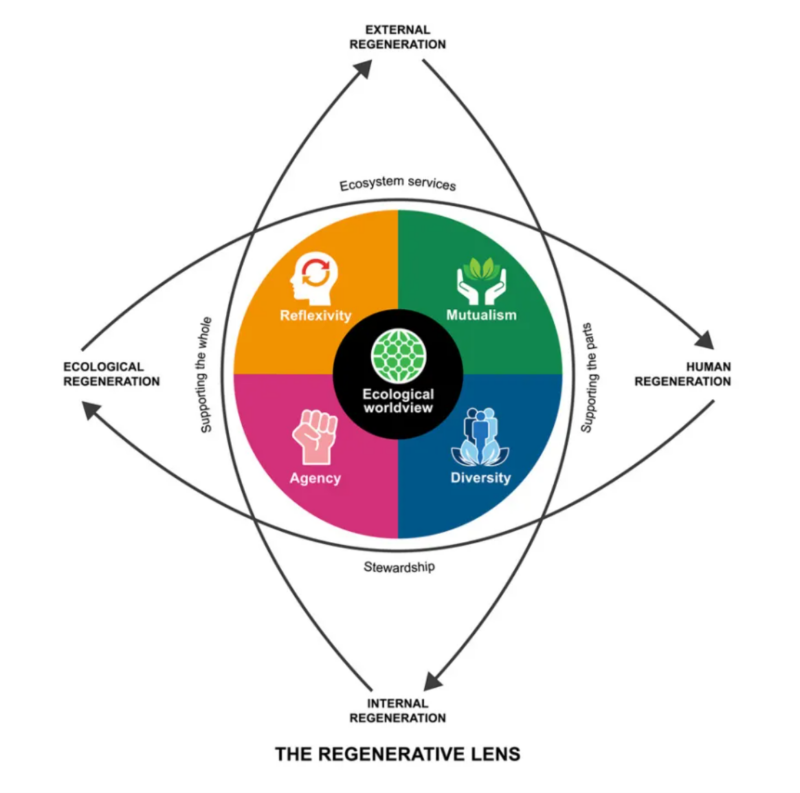
As I understand it, regenerative thinking is a mindset that requires empathy towards our nature’s wellbeing while recognizing our planet’s limitations. I find this empathetic behaviour development to be similar to product development processes where developers need to empathize with the needs and pain points of the challenge space stakeholder. Regenerative thinking also seeks to foster a shared ecological worldview across different disciplinary perspectives, encouraging collective action towards the regeneration of social-ecological systems (Image 1). Buckton et al. (2023, p. 15) point out that “as increasingly deadly extreme weather events drive home the reality of our environmental crises, narratives of reducing harm to sustainable levels . . . dominate, perpetuating the notion that we can continue to improve current societal patterns.” However, as they point out, we need more significant transformations than this.
Regenerative thinking goes beyond traditional sustainability or its development, requiring every individual in their own field to consider actively restoring, renewing, and improving natural and social systems instead of, for example, just trying reach zero emissions. Ultimately, the purpose of this larger view on sustainability and regenerative thinking is to enable life and communities to continuously thrive and grow during future generations. Similarly, Gosnell and Gordon (2025) present regenerative thinking as a holistic lens for different fields, such as living systems theory, systems thinking, and resilience thinking – even as they also consider regenerative mindsets as being regenerative through connectedness with nature, community dynamics, and learning.
Nonetheless, as Buckton et al. (2023) discuss, regenerative thinking depends on a radical shift in mindset that requires individual and group actions alike. This requires focusing on the growing, circular, and sustainable systems while reinforcing all wellbeing to provide a transformative message (Buckton et al., 2023).
Including regenerative thinking into education subjects
The courses that I teach through the HAMK Design Factory provide students with opportunities to develop various practical skills, such as carpentry, metal working, 3D printing, laser printing, large scale printing, or prototyping based on data. Within these subject studies, education is provided either through independent 1–2 credit workshop courses or they are incorporated into larger courses, such as product development, where prototyping is valuable. Figuring out how regenerative thinking can be incorporated into these subjects may present a challenge, depending on what kind of prototyping or practical skill is to be learned.
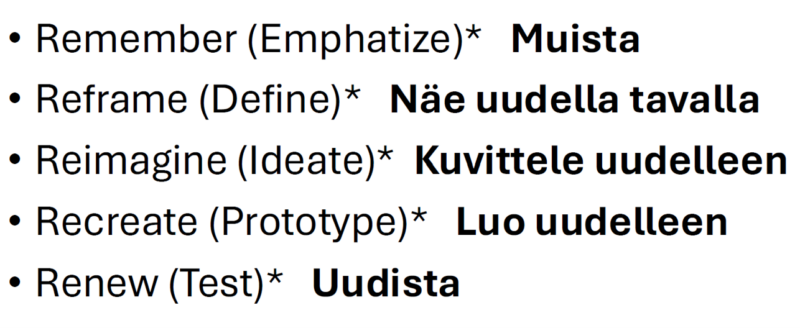
Due to being very similar to the different development processes within product development and theory, however, regenerative thinking seems to most effectively align with product development education models or the design thinking process itself. This became apparent at the regenerative thinking seminar where it was presented as a further-iterated version of the design thinking process, approached from the regenerative perspective (Image 2). By visualising the two processes side by side, we can create a clearer framework for incorporating regenerative thinking into the students’ product development projects. This would allow students to consider relevant regenerative principles throughout each phase of their projects. Also, it could make it easier for the students to understand how regenerative thinking can be applied to specific phases of their projects, such as the ideation, prototyping, and testing phases.
Outside of product development education processes, incorporating regenerative thinking into subjects that focus on physical skill development is another matter which requires more discussion and development. One example of this would be providing a 3D printing workshop with the sole purpose of effectively teaching the students the needed basic practical skills and theory. While learning such practical skills does not connect as directly to teaching product development, the basic 3D printing workflow can still follow a linear approach, where users typically prepare a print, consume a predetermined amount of filament, and discard leftover support material or unsuccessful prints. Within our Design Factory 3D print workshop, we educate students about the variety of materials, different printing technologies, the advantages and disadvantages of 3D printing, and the recyclability of parts and print material.
However, from a regenerative thinking point of view, we need to consider our holistic thinking within circular sustainability through a step-by-step approach (Gibbons, 2020; Yunibandhu & Hallinger, 2025). In addition to taking a sustainable perspective, regenerative thinking is about the broader picture where we consider, for example, how the electricity for printing is produced, what possible fumes we are producing from the printing, or how we can use print materials that are actually environmentally friendly. Many filament-based material types are problematic from a biofriendly perspective and there is a limit on the recyclability of already printed parts (Fico et al., 2022; Pakkanen et al., 2017). For example, even though polylactic acid filaments (PLA) or other similar filaments are marketed as being biodegradable, in reality they require specific environments to biodegrade, or even if they biodegrade, they still contain chemicals that are not environmentally friendly (Afshar et al., 2025; Mazur et al., 2025; Momeni et al., 2023; Nomadolo et al., 2022). When it comes to recycling already printed parts, users should recycle them with other plastics of the same type and not mix, for example, PLA and PETG. Also, when creating recycled filament, users need to incorporate a certain percentage of untouched filament into the mix to maintain quality and durability of the material.
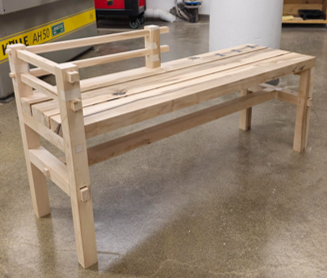
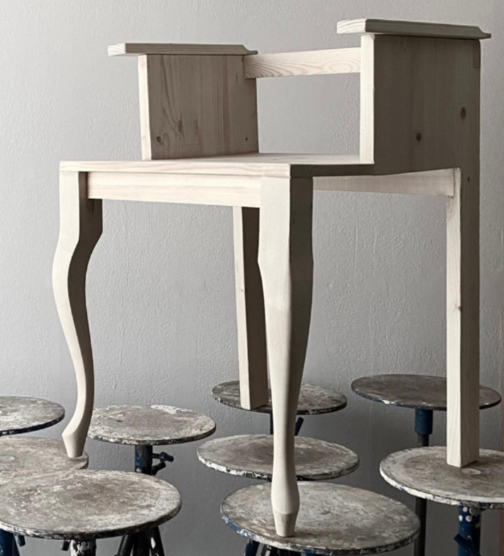
While 3D printing is challenging from a regenerative perspective, there are other physical skills subjects that show more promise. For example, our Design Factory carpentry basics course has a similar goal of teaching the students the needed skills and theory to get started in carpentry and to become able to later independently develop their skills. Within this course, the students learn the theory side of carpentry, initial history of different styles, different techniques, wood species, sustainably friendly material sources, and the machines or tools available to them. I have noticed that many students have taken the more sustainable path with their material and manufacturing choices for their projects. Some students have decided to learn carpentry from a traditional and minimalist perspective, focusing on manufacturing without glue, nails, or screws (Image 3), while others have decided to make furniture using only such wood materials that have already been processed and were not meant to be reused (Image 4). More specifically, in the latter example (Image 4), the student decided to find parts and materials from already existing furniture in a flea market. Some may feel that this approach is controversial from a restorer’s perspective as it leads, for example, to ripping an already-made table surface from its legs and planing it flat to make a cabinet door. However, if we consider the circularity of wood furniture, at some point such pieces of furniture most commonly end up in landfills, or they might be destroyed in another manner, which is not a viable option either. From the circularity and regenerative thinking perspectives, I have also begun to consider other potential opportunities. For example, could we turn our continuously accumulating sawdust and woodchips into something reusable?
From traditional sustainability to active restoring
Regenerative thinking moves beyond traditional sustainability by focusing on actively restoring and renewing natural and social systems rather than just minimizing harm. Participating in the regenerative seminar highlighted how this mindset can align with the types of design thinking processes that we can use in our product development courses. For example, such an approach can be helpful in providing more information, sustainable perspectives, and development opportunities for students, as they become future innovators who shape the direction of environmentally friendly actions for our planet.
Although regenerative thinking may not fit into every educational subject – such as 3D printing, prototyping using unique machining processes, or other practical skill that is learnt through educational workshops – it still presents unique challenges and development opportunities for empathetic development for the well-being of our planet. For example, 3D printing requires rethinking material lifecycles, energy sources, and waste management, and carpentry naturally seems to invite circular approaches, such as repurposing already existing furniture as a material source. Ultimately, incorporating regenerative thinking into both creative and practical technical education could encourage students to consider the broader environmental implications of their activities. It can also provide opportunities to rethink linear working processes and develop more circular approaches in which materials and by-products are kept in use for as long as possible.
References
- Afshar, S. V., Boldrin, A., Christensen, T. H., Corami, F., Daugaard, A. E., Rosso, B., & Hartmann, N. B. (2025). Disintegration of commercial biodegradable plastic products under simulated industrial composting conditions. Scientific Reports 15, 8569. https://doi.org/10.1038/s41598-025-91647-z
- Buckton, S. J., Fazey, I., Sharpe, B., Om, E. S., Doherty, B., Ball, P., Denby, K., Bryant, M., Lait, R., Bridle, S., Cain, M., Carmen, E., Collins, L., Nixon, N., Yap, C., Connolly, A., Fletcher, B., Frankowska, A., Gardner, G., . . . Sinclair, M. The regenerative lens: A conceptual framework for regenerative social-ecological systems. One Earth 6(7), 824–842. https://doi.org/10.1016/j.oneear.2023.06.006
- Fico, D., Rizzo, D., Casciaro, R., & Esposito Corcione, C. (2022). A review of polymer-based materials for fused filament fabrication (FFF): Focus on sustainability and recycled materials. Polymers, 14(3), 465. https://doi.org/10.3390/polym14030465
- Gibbons, L. V. (2020). Regenerative—The new sustainable? Sustainability, 12(13), 5483. https://doi.org/10.3390/su12135483
- Gosnell, H., & Gordon, E. (2025). Inner dimensions of regeneration: Mental models, mindsets and cultures. Challenges, 16(3), 39. https://doi.org/10.3390/challe16030039
- Mazur, J., Sobczak, P., Panasiewicz, M., Lusiak, P., Krajewska, M., Findura, P., Obidziński, S., & Żukiewicz-Sobczak, W. (2025). Mechanical properties and biodegradability of samples obtained by 3D printing using FDM technology from PLA filament with by-products. Scientific Reports, 15, 5847. https://doi.org/10.1038/s41598-025-89984-0
- Momeni, S., Craplewe, K., Safder M., Luz S., Sauvageay, D., & Elias, A.(2023). Accelerating the biodegradation of poly(lactic acid) through the inclusion of plant fibers: A review of recent advances. ACS Sustainable Chemistry & Engineering, 11(32), 15146–15170. https://doi.org/10.1021/acssuschemeng.3c04240
- Nomadolo, N., Dada, E. O., Swanepoel, A., Mokhena, T., & Muniyasamy, S. (2022). A comparative study on the aerobic biodegradation of the biopolymer blends of poly(butylene succinate), poly(butylene adipate terephthalate) and poly(lactic acid). Polymers, 14(9), 1894. https://doi.org/10.3390/polym14091894
- Pakkanen, J., Manfredi, D., Minetola, P., & Iuliano, L. (2017). About the use of recycled or biodegradable filaments for sustainability of 3D printing. In G. Campana, R. Howlett, R. Setchi, & B. Cimatti(eds.), Sustainable design and manufacturing 2017 (Vol. 68, pp. 776–785). Springer International Publishing. https://doi.org/10.1007/978-3-319-57078-5_73
- Yunibandhu, R., & Hallinger, P. (2025). From sustainability to regeneration: Mapping the conceptual foundations and future directions of regenerative development. Sustainable Development, 33(6), 8569–8585. https://doi.org/10.1002/sd.70112
Author

Markku Mikkonen
Senior Lecturer
HAMK Design Factory
Häme University of Applied Sciences