

There are currently 73 European Universities Alliances which include participants from altogether 28 Finnish higher education institutions (European Commission, 2026). This activity rises from the European Universities initiative which supports long-term cooperation between higher education institutions across Europe. While the objectives of these various university alliances may differ, overall they aim at increasing the international competitiveness of European higher education institutions. In addition to this, they seek to champion European values and identity, and they work to promote cooperation between higher education institutions in a way that takes a long-term structural approach but is also strategic and sustainable (European Commission, 2025).
This article examines how European University alliances reach students, one of their key target groups, and explores how the flow of communication between partner universities within the alliances could be improved. European University Alliances often face the challenge that while they offer the students opportunities for taking joint degrees and engaging in mobility and collaboration, many of the students are not aware of these opportunities or they do not know how to get involved. This raises the question: How can the alliances bridge this gap and better connect with students?
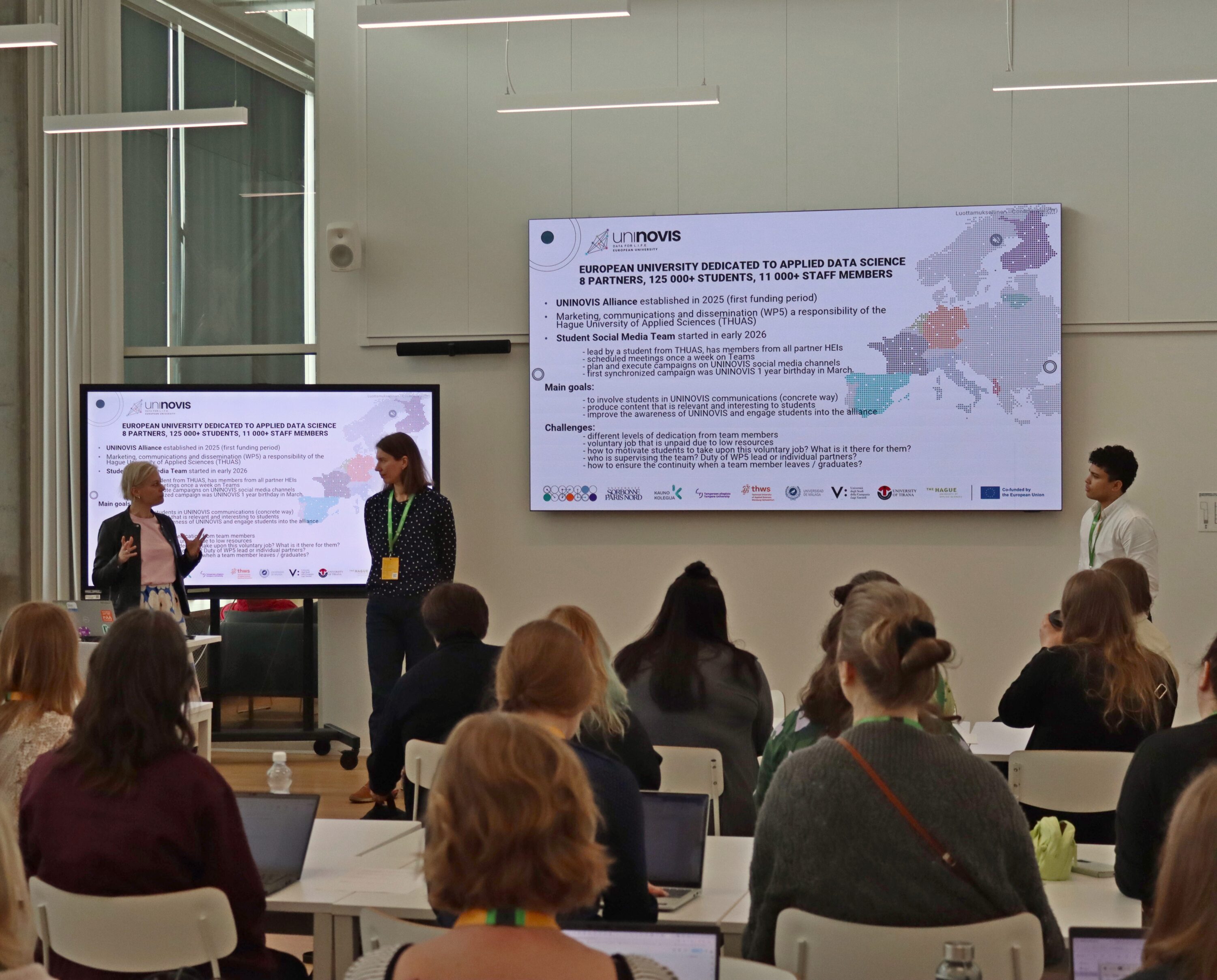
We sought answers to this question at our panel at the May 2026 annual Spring Forum for Higher Education International Affairs which brings together professionals who specialize in international affairs at higher education institutions (Finnish National Agency for Education, n.d.). Nearly 60 participants from European University Alliances and higher education institutions (HEIs) attended our session and shared their insights and experiences. Our discussion focused on how to better reach students, and as the participants included communication and marketing specialists, international officers and local alliance coordinators, but also welcomed everyone who wanted to know more about effectively engaging and communicating with students in transnational higher education contexts, this provided an opportunity for wide-ranging discussion.
Our session at the event was organized as a rotating discussion so that all participants in turn engaged with the themes of storytelling and student voices, coordination strategies for alliance-wide and local-level engagement, and lessons learned from experiences with student communication. Discussing each of these themes was facilitated by specialists from their respective alliances: RUN European University (RUN-EU), European University for Customised Education (EUNICE) and Data for L.I.F.E. (UNINOVIS). In the following, we examine in more detail the key takeaways from discussions on these themes.
Storytelling and student voices
The session participants discussed various approaches to effectively gathering and sharing student stories from university alliance experiences and on amplifying the students’ voices. We all agreed that sharing real-life student experiences is an effective way to encourage other students to participate in alliance activities, to demonstrate what alliance work truly means, and to highlight the impact of alliances.
This can be achieved through various posts published, for example, on social media or as articles, and they may cover topics such as enrolment and travel tips, “my day” stories, and insights from lectures and free time. However, although the session participants saw social media and website articles as good ways to expand reach, all agreed that face-to-face encounters still play an important role.
Identifying and collecting student stories
Based on our own experiences and those of the session participants, identifying potential storytellers and collecting authentic stories can be challenging. This is partly because stories are often requested directly from students only when needed or gathered through teachers who are more familiar with the students. Another challenge in terms of motivation is that students are rarely compensated for sharing their experiences, and this may lead to situations where they have little motivation to prepare content for HEI channels.
One useful, though still relatively underused, approach is to collect student testimonials systematically while gathering feedback from courses and events. Such survey feedback can be used in communication, for example, as testimonials, if permission has been requested appropriately. The session participants also agreed that feedback should be collected immediately after the activity, so that the testimonial provides as realistic a view as possible.
To collect student stories, some alliances and HEIs have prepared communication templates that may include guiding questions and tips on what to consider when preparing a social media post or a website article. In our discussion, we agreed that while these templates may be useful tools, they are not always very effective, especially if collecting student stories is not part of an existing process or coordinated systematically by HEI staff. The session participants also discussed whether there is a danger of losing the authenticity of the testimonial when student experiences are shared within institutional frameworks. For example, if the testimonial is based on guiding questions in a template or feedback survey, can it truly be said that students are sharing their authentic experiences?
Digital vs analog approaches
In our session, we also discussed how to attract the students’ attention. We shared the view that while social media remains one of the most important tools for connecting with students, it has its limitations. Creating appealing and authentic content with good reach requires time and expertise. Some institutions manage their social media accounts through their staff, while others also maintain student-led accounts that focus on sharing international student experiences. The session participants also discussed whether institutional social media posts may be less effective than the students’ personal social media accounts. Messages from fellow students can feel more relatable and trustworthy, especially when they are shared in a personal and conversational way. This can also help to strengthen the students’ sense of belonging (Galiato et al., 2025). Moreover, algorithms often prioritize content based on relationships and previous interactions, giving peer-to-peer content the potential for greater visibility (Nekvasil, 2026).
Some HEIs have found analog approaches effective. This means that instead of online communications, students can share their alliance experiences peer-to-peer, for example, at student events and lectures. In face-to-face discussions, students can ask questions and talk about their experiences in a relaxed and approachable way. In some cases, in-person discussions can therefore be more impactful than digital approaches, as they allow students to share their experiences personally and directly with their peers.
In addition to this, AI was seen as a tool that could be used more effectively in student communication and information sharing. For instance, HEIs could create AI bots that students could use to ask about international opportunities. Student testimonials could also be shared through the bot. Overall, however, both digital and analog approaches were considered important and mutually complementary.
We also agreed that collaboration with alliance partners is one of the key factors in collecting and sharing student experiences. Many alliances collect feedback and student stories from in-person events, courses, and other activities, and the hosting organization is often responsible for this collection. Our session participants agreed that establishing a common, systematic process that takes data management and General Data Protection Regulation (GDPR) into account is essential when collecting and sharing student stories with alliance members. A joint process would also make the workflow more efficient since alliance members would not need to collect their own banks of testimonials. However, the participants also pointed out that student experiences may not always feel relatable across different parts of Europe. For example, what is considered an interesting topic or appealing tone of voice may differ between students of different ages or cultural backgrounds.
Balancing between alliance-wide and local communications
Based both on our own experiences and those of the session participants, balancing between the needs of alliance-wide and local communication is like walking on a tightrope. While it was commonly acknowledged in the discussion that some alliance-wide coordinating structures are needed, these structures were, perhaps paradoxically, also seen as a hindrance to effective and timely communication flows. Different academic structures and organizational practices, as well as varying priorities between participating HEIs, were identified as main reasons behind these challenges.
Different structures and varying content
One of the key challenges mentioned by almost all session participants was aligning national timelines and communication processes between alliance partners. Academic schedules between countries differ, making joint communication campaigns sometimes difficult to manage. For example, when Finns start their academic year in August, the majority of our European colleagues are still on their summer holidays. Meanwhile, anyone who has ever studied at a Finnish university knows that May is hardly the best time to reach students who are busy celebrating the May Day and then taking their exams. So, for the communication measures to be effective, they should be tailored to suit local needs and schedules – even if that means not doing everything in sync.
Another structural factor affecting communications within university alliances seems to be the lack of necessary human resources and competences. The session participants recognized that not all staff members involved in alliance communication and marketing have expertise in these areas. In some cases, communication is led by teachers, researchers, or international office personnel, not the institution’s communication specialists. As pointed out by the session participants, this can lead to inconsistencies and reduced clarity. Similarly, resources allocated to alliance communications were often seen as comparatively meagre, meaning that staff members involved in these activities had to squeeze the hours from their “regular work.” Only in cases where the university was the general coordinator of the alliance or led the work package on communications, were the resources seen as more adequate.
The topic that raised perhaps the most discussion at our session was the relevance of shared content, such as news articles, social media posts, and info campaigns. It was pointed out that what works at the alliance level does not necessarily resonate locally, and vice versa. The wider and the more culturally diverse the alliance is, the more difficult it is to formulate content that speaks to all audiences. Sometimes even language barriers prevent the message from being conveyed to everyone in the same manner.
Meanwhile, there are also differences between European countries as regards the use of social media and the channels that are perceived as relevant. For example, Facebook is still widely used by students in Italy, while in Scandinavia it has largely lost its appeal among younger generations. Majority of the session participants confessed that they often modify the alliance-wide communication campaigns and unified content to better suit their local needs or, even more drastically, skip them altogether.
From challenges to solutions
Despite the above-mentioned challenges, our session participants put forward several strategies to remedy the situation. It was agreed that successful alliance-wide coordination should rely on shared planning frameworks, such as annual communication plans with clear deadlines for all partners, combined with a degree of flexibility. Building awareness of cultural and operational differences across countries – and accepting them – is essential. This includes taking into account nation-specific academic structures and schedules. In addition, practical storytelling formats, such as mobility testimonials (for example, in video or blog format), can help translate alliance-level activities into more relatable local content.
The discussions also emphasized the importance of engagement and collaboration structures that involve student unions and ambassadors to strengthen communication and outreach across the alliance. This would mean creating voluntary communication roles, peer student networks, and local “community messengers” who help translate and share key messages within their own contexts. Strengthening peer-to-peer communication is particularly valuable, as it increases trust, relevance, and accessibility of information. By empowering students to act as communicators and facilitators, the alliance can enhance dissemination, foster a sense of ownership, and ensure that information flows more effectively both horizontally and vertically.
Looking into the future, participants identified several ways to improve communication practices within university alliances. These include more targeted and tailored communication to suit local needs, better alignment of planning cycles, and more leeway to staff members involved in alliance communications locally. Furthermore, face-to-face collegial interaction was seen as a key enabler for building trust and mutual understanding – both of which are essential for smooth cooperation. For this reason, regular visits to partner universities and yearly meetings amongst alliance staff members were seen as vital activities that should be written into the grant agreements to secure adequate travel funding.
Overall, the discussion at our session demonstrates that instead of uniformity, effective communications coordination is about finding the right balance between shared direction and local flexibility, supported by trust, clear structures, and continuous dialogue. We can also conclude that for alliance communication to succeed, HEIs need to pay more attention to recruitment and resource allocation to communications. As became apparent in our discussion, such resources make it possible to build long-lasting collaboration structures to support dissemination both during and after funding periods.
References
- European Commission (July 13, 2026).European Universities alliances and their partners. https://education.ec.europa.eu/education-levels/higher-education/european-universities-initiative/map
- European Commission (May 13, 2025). The European Universities alliances in action. https://education.ec.europa.eu/education-levels/higher-education/european-universities-initiative/about
- Finnish National Agency for Education. (n.d.). Spring Forum for Higher Education International Affairs. https://www.oph.fi/en/programmes/spring-forum-higher-education-international-affairs
- Galioto. M., Pedone, F., Vantarakis, A., Tavares, P. & Bianco, A. (2025) The use of social networks in institutional communication at university: a prospective pattern for enhancing the sense of belonging among students. Frontiers in Communication, 10, 1523295. https://doi.org/10.3389/fcomm.2025.1523295
- Nekvasil, N. (January 28, 2026).The Instagram algorithm: How it works and strategies for 2026. Sproutsocial. https://sproutsocial.com/insights/instagram-algorithm/
Authors


Rasmus Syrjänen
Assistant, EUNICE, University of Vaasa
Kirsi Popova
Communications Specialist, UNINOVIS,Tampere University of Applied Sciences