
The past decades have seen a rapid expansion and a massive increase in open data (Sadiq & Indulska, 2017), with governments, multilateral institutions, non-profit organisations, individual researchers, and others opening their datasets digitally for the public. When used well, open data provides significant opportunities for educational use. To promote open data usage in education and to help overcome some of the related challenges, this article provides a short overview of how to use open data in education and why it should be harnessed. Furthermore, this article lists a few reliable, global databases that can be used in education.
It is worth noting that this article does not provide ready, practical solutions on how to integrate open data into education, but it aims to act as inspiration. Teachers and educators should test and see what works best for them and their students within their specific institutional settings. This article is produced as part of the EU-funded SUSFOR-project, which focuses on forestry education. Thus, the scope of the article is centred on forestry databases.
Benefits of open data and its use in education
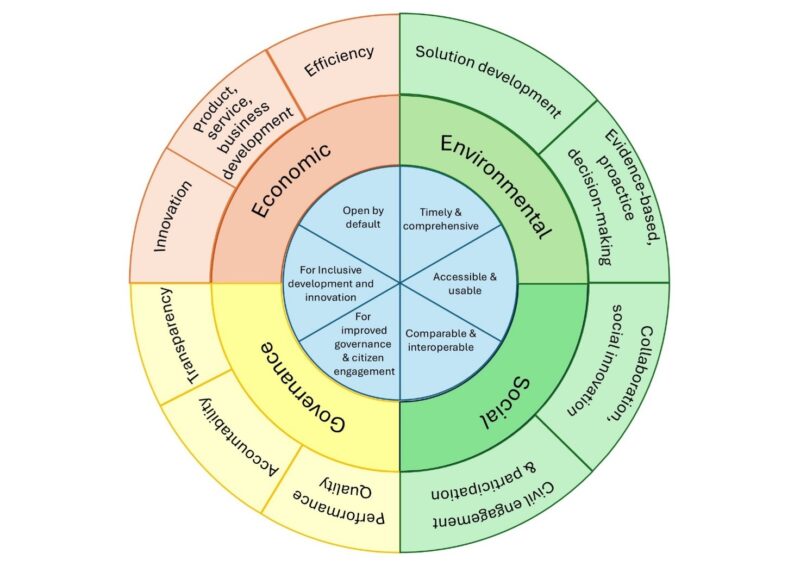
Open Data Charter (2015) defines open data as “digital data that is made available with the technical and legal characteristics necessary for it to be freely used, reused, and redistributed by anyone, anytime, anywhere”. Open Knowledge (2015) explains that “[o]pen data and content can be freely used, modified, and shared by anyone for any purpose”. It is important to distinguish open data from open-access data. Open data, by its definition, refers to data without usage restrictions. Open-access data, in turn, refers to data that has been made technically and financially available to the public, but it may still have usage restrictions regarding, for example, distribution, reuse, and remixing (Springer Nature, 2020). The rapid expansion of data availability and openness has been associated with various economic, environmental, and social benefits (Figure 1). Open data can enhance (data-driven) innovation, product, service and business development, and efficiency, subsequently driving economic growth (EU, 2015, 2018, 2019; Sadiq & Indulska, 2017). Open data can also be used to monitor and identify ongoing trends, detect concerns, measure impact, model scenarios, and predict future impacts related to socio-economic and environmental issues (EU, 2024; Ncube & Ngulube, 2024). Thus, it provides a basis for proactive and evidence-based decision-making and designing solutions to address environmental and societal challenges (EU, 2019, 2024; Finck & Mueller, 2023; Ncube & Ngulube, 2024). Moreover, equal, non-discriminative access to data and its use can empower citizens, enhancing their participation in democratic decision-making, societal life, and politics, promoting collaboration and accelerating social innovation, contributing to societal and human well-being, and active citizenship (Atenas et al., 2015; EU, 2015, 2019). Utilisation of open data can improve the performance and efficiency of research, governance, public administration, and spending, and ensure informed decision-making (EU, 2015, 2019). Opening of government data, in turn, improves transparency and accountability of government decisions and actions (EU, 2015; Saddiqa et al., 2021), which can increase trust and prevent corruption. The potential benefits of opening data have led to its increased promotion, for example, by research and project funders and government agencies. To promote the usability, utility, practical value, and positive impact of open data, the Open Data Charter (2015) lists six principles for publishing data, developed together with a set of stakeholders (Figure 1).
However, the benefits of open data do not materialise by themselves. Tapping into these potentials requires dedicated efforts and competencies to find reliable databases, assess the data quality, filter relevant datasets or parts of them, and analyse and interpret the data in addition to mere digital and technical skills to manage and operate with the data. This type of data literacy has become a crucial skill for operating within the so-called information and data overload and for maximising the benefit of constantly accumulating data (Atenas et al., 2015; EU, 2018). In today’s society, it is as important to know how to use existing data as it is to collect and produce new data.
Education plays a crucial role in imparting these skills to students and future professionals, enabling them to operate in a knowledge-based and data-driven society (Atenas et al., 2015). On the other hand, teachers can utilise open data as authentic material in teaching (Atenas et al., 2015). According to Atenas et al. (2015), open data can act as free, real-life learning material supporting teaching and learning and offering students the possibility to develop core competencies.
UNESCO (2024) defines open educational resources (OER) as “learning, teaching and research materials in any format and medium that reside in the public domain or are under copyright that have been released under an open license, that permit no-cost access, re-use, re-purpose, adaptation and redistribution by others”. Following this definition, when used for educational purposes open data can be considered as OER, regardless of whether its original publication purpose was educational or not (Atenas et al., 2015; Coughlan, 2020). As an OER, open data can be used simultaneously as a source of knowledge and information, and as a practical tool and method to practice data literacy and data management skills, the same way students are likely to use and manage data in their future professions (Atenas et al., 2015). Open data, like all OER, can be considered especially useful and beneficial to institutions that have limited access to fee-based educational and research materials and resources. Despite its recognized potential, open data has not attained a firm foothold in education, but remains largely under- or even unutilised, as attention has mostly been on open data utilisation for business and research purposes (Atenas et al., 2015; Coughlan, 2020; EU, 2018). In spite of open data’s vast recognised potential in educational settings, it is most used in higher education, with secondary and vocational education lagging behind in application (Saddiqa et al., 2019; Saddiqua et al., 2021).
Various factors have been recognised for hindering the use of open data in education. Educators may lack overall awareness of how to integrate data into teaching and learning, and they may not be aware of the possibilities that open data has to offer (Coughlan, 2020; Saddiqa et al., 2021). Indeed, limited data literacy skills constrain the use of open data. Data literacy gaps relate especially to the aspects of finding relevant and suitable data as well as to managing and transforming the data into a pedagogically sound resource. Teachers may also be unaware of (reliable) open-access data portals and databases (Coughlan, 2020; Saddiqa et al., 2021). In addition, finding data to fulfil a given function, for example, using raw data for practicing data management or finding data from one geographical area, can be challenging (Coughlan, 2020). Data derived from a database, in many cases, is not sufficient or “self-ready” educational material, but requires management, modification, and preparation – such as extracting sub-sets, visualising data, and transforming data into a different form – all of which require deliberate knowledge and skills (Coughlan, 2020; Saddiqa et al., 2021). These identified steps in using open data for education, including planning how to use open data, finding relevant data sources, and modifying the data to serve educational purposes, take time, which may be a limited resource for teachers (Saddiqa et al., 2021). Finally, even if open data itself is free, accessing and using it requires digital resources, such as internet access and computers, which may also constitute a limiting factor in teaching (Saddiqa et al., 2021).
Approaches to using open data in education
Open data as open education resource is not restricted to specific study levels or disciplines, but its use can be tailored to meet the requirements and opportunities in secondary school, high school, vocational education, and higher education, spanning all subject areas. Likewise, open data can be integrated into various pedagogical approaches and modes of teaching. Coughlan (2020) and Atenas et al. (2015) reported open data to be especially suitable for inquiry-, project-, problem-, and research-based learning as well as in student-centred approaches. By working with data, students take an active role, becoming knowledge creators rather than knowledge consumers (Atenas et al., 2015). Open data literacy gives students access to real-life data they can use as background material and in assignments, student projects, thesis work, and other study tasks.
Educational usage of open data can be roughly categorised into five closely interlinked and partially overlapping modes. These five modes are illustrated in Figure 2 and explained in more detail below.
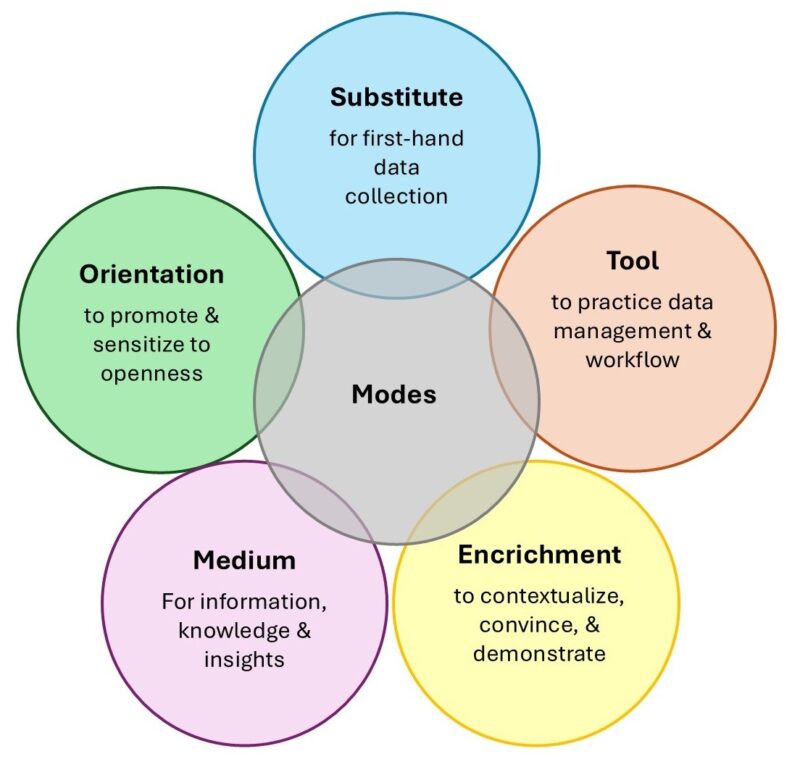
Substitute (for first-hand data collection)
Primary data collection during studies may not be possible due to, for example, economic, time-related, or logistical constraints, or it may not be otherwise justified. Open data can be used to replace or complement primary data (Coughlan, 2020). In both cases, it connects students with the real world, with real-life learning experience, practicing the same data management competencies as with self-collected data, and producing equally relevant and usable outputs (Atenas et al., 2015; Coughlan, 2020). It is worth noting that data collection from open sources (which is a practice called “secondary data collection”) is as valid and genuine as primary data collected carried out directly by students. In fact, open data sources and secondary data are constantly used to conduct novel research.
Tool (to practice data management and workflow)
Open data, in its raw form, is a beneficial resource for practicing data literacy and management, from data quality assessment to data storage and organisation, analysis methods and software usage, data visualisation, interpretation, drawing conclusions, and communicating and reporting findings. All of these are core skills of the 21st-century worker. For novelty, students can use more than one dataset for making comparisons or finding patterns (Coughlan, 2020).
Enrichment (to contextualize, convince, and demonstrate)
Open data can enrich teaching by providing “hard” evidence, grounding teaching in reality through real-life data, and demonstrating trends visually and/or numerically through, for instance, existing (or self-created) interactive maps. Open data can also be used to enrich learning by offering students the possibility to contextualize and personalise their learning (Coughlan, 2020) through using datasets and sources related to their specific interest areas. The findings that Saddiqa et al. (2021) present suggest that enriching teaching with open data improves students’ understanding of the given topic.
Medium (for information, knowledge, and insights)
Knowledge does not need to be derived from literature, such as books and articles. It can also be derived from data. In various fields, constantly updated or otherwise recent datasets can be a more relevant knowledge source than older literature, especially within time- and location- or otherwise specific cases (such as annual forest loss or forestry contribution to GDP). Open data can be used as learning material for students (EU, 2018) to better understand a specific topic area (Saddiqa et al., 2021), as well as background material for teachers to develop teaching materials (Coughlan, 2020).
Orientation (to promote and sensitise openness and transparency)
Coughlan (2020) refers to the promotion and increase of open data as a “global movement” (p. 383) and Atenas et al. (2015) as an ‘‘opening movement” (p. 378) which is interconnected to other trends such as the open education approach, open science, and open access publishing. Use of open data in education orients and sensitises students to these open approaches, simultaneously promoting core values and open data benefits, such as transparency, accountability, and equal accessibility. In addition, engagement with open data can increase awareness of data privacy and security issues (Coughlan, 2020). Demand and usage of open data in education (or otherwise) creates pressure and incentive to open databases, and it can thus lead to more data becoming openly available (Coughlan, 2020).
Benefits of using open data in education
Usage of open data as OER is associated with a variety of educational benefits. Though the benefits are interlinked, a rough distinction can be made into the following aspects: improved educational efficiency and access to teaching and learning materials, authenticity, societal engagement, relevancy, competence development, motivation and activity, and teachers’ professional development (Table 1, Figure 2).
Table 1. Benefits associated with the usage of open data as OER in education, divided into highly interlinked categories. Sources: Coughlan (2020), Saddiqa et al. (2021), and Atenas et al. (2015).
| Category | Benefit description |
|---|---|
| Educational efficiency and access to teaching and learning materials |
|
| Authenticity and societal engagement |
|
| Relevancy & Responsiveness |
|
| Competence development |
|
| Motivation & activity |
|
| Teacher’s professional development |
|
Whilst open data has the potential to create concrete benefits in education, it cannot, of course, fully replace primary data collection or engagement with society. Open data can complement or act as a starting point for authentic learning, but for students to fully grasp the real-life complexity and to learn from mistakes, hands-on data collection and engagement with stakeholders is a must (Coughlan, 2020). Open data also covers only a small fraction of existing data, or data that should exist. As one of the interviewees in Coughlan’s (2020) interview put it: “It is not enough to work with the open data that is there. You should also be asking questions about the data that is not there” (p. 397).
Global Open Databases
Table 2 contains an example in the form of a list of currently available open databases and portals that can be useful in forestry-related education especially, but also for related disciplines. Most of the datasets in the table are open with a CC-BY license, yet some have restrictions regarding use and (re)distribution, and thus they are not open data by its strict definition, but rather open-access data. The listing provides only a snapshot, and I strongly recommend that interested individuals themselves explore the opportunities these datasets have to offer. Taking into account the constantly changing nature of the internet, readers should also keep in mind that the table below is based on the information available at the time of writing this article, and it may be subject to changes. In addition, new data portals may, and are more than likely to, emerge.
Table 2. An example list and a snapshot of global databases and portals, with data relevant for forestry.
| Data portal | Website | Description | License |
|---|---|---|---|
| World Bank Open Data | https://data.worldbank.org/ | Global development data, easily browsable based on indicator, country, or region. Data source from the World Bank Group and its partners. The World Bank Open Data are currently upgrading their database. | CC BY 4.0 with additional terms |
| FAOStat | https://www.fao.org/faostat/en/ | Food and agricultural data (including land-based data), divided into 17 domains with sub-categories (elements and items). Data from 254 countries since 1961. | CC BY 4.0 complemented with FAO Statistical database terms of use |
| FAO global forest resources assessment | home: https://www.fao.org/forest-resources-assessment/en data: https://fra-data.fao.org/ | Reports and data (data since 1990) from the Global Forest Resources Assessment, conducted currently every five years. Data browsable by region or country. | CC BY 4.0 complemented with FAO Statistical database terms of use |
| Global Forest Watch by World Resources Institute | https://www.globalforestwatch.org/ | Forest monitoring data, technology, and tools, incl. country dashboards and interactive maps of forest change, land cover, land use, climate, and biodiversity. | CC BY 4.0 |
| Open-foris initiative | https://www.openforis.org/ | Tools for and visuals on forest and land monitoring, including field data collection, visual interpretation, data management, geospatial analysis, and integrated solutions and risk assessment. Access to some of the tools requires signing up. | Differs per resource |
| Climate watch | https://www.climatewatchdata.org/ | Datasets, visualisations, and resources on climate-related data and Nationally Determined Contributions. Possibility to create, save, and share customised data visualisations. | CC BY 4.0 |
| Plants of the World Online by Royal Botanical Gardens Kew | https://powo.science.kew.org/ | Data on plants, including taxonomy, identification, images, distribution, traits, threat status, molecular phylogenies, and uses. Data sources from the Royal Botanic Gardens, Kew, and its partners. Includes “1,444,000 global plant names, 530,400 detailed descriptions, and 509,900 images” | See “terms described in the license field of individual dataset records (metadata)” |
| OECD data | https://www.oecd.org/en/data.html | Datasets on almost 300 indicators on different policy categories, complemented with different tools and dashboards. | May vary by the data source, confirm from metadata or the data source |
| The IUCN Red List of Threatened Species by the International Union for Conservation of Nature | https://www.iucnredlist.org/ | Data on the global extinction risk of animals, plants, and fungi. Not open data by its strict definition, as it does not allow commercial use of the data. | CC-BY-NC |
| Global tree portal by Botanic Gardens Conservation International | https://www.bgci.org/resources/bgci-databases/globaltree-portal/ | Data on almost 60 000 tree species, incl. distribution, conservation status, and conservation actions. Data can be browsed through species, country, or global overview. Not open data by its strict definition, as it does not allow commercial use of the data nor distributing modified material. | CC-BY-NC-ND |
Conclusions
Data is a crucial and important resource that, if opened and made available, can unlock a wide variety of societal and individual benefits. The educational sector is at the forefront of promoting the “opening movement” and developing the core skills needed to manage and make the most of the constantly accumulating data. On the other hand, education can significantly benefit from open data as an open educational resource. Open data can be used by various means, as presented in this article, to create learning outcomes and other benefits, from enhanced motivation to improved educational relevance. Whilst open data is usable and beneficial for all educational institutions, it can be especially valuable for institutions that have limited access to fee-based educational and academic resources or limited possibilities to conduct primary data collection.
Open data use in education is well aligned with modern pedagogical approaches, such as active, student-centred learning, project-based learning, and design thinking approaches. Moreover, open data aligns well with an open education approach that aims to increase access to education, often using digital platforms and open educational resources that are available beyond officially enrolled students. Regardless of the study subject, the educational level, or the overall purpose of utilising open data in the physical or digital classroom, this approach requires deliberate effort and planning.
The constantly increasing availability and diversity of open data offers vast and unprecedented opportunities for the educational sector. However, getting started may feel challenging. Because of this, it is important to remember that no one is born a master – utilising open data requires practice, which may include trial and error. The aim of this article was to provide an overview of how (and why) to use open data in education, and it presented a few reliable open databases to start with. I hope that this article has provided inspiration for educators and lowered the threshold to bringing open data into everyday educational delivery.
References
- Atenas, J., Atenas, J., Havemann, L., & Priego, E. (2015). Open Data as Open Educational Resources: Towards Transversal Skills and … Open Praxis, 7(4), 377–389. https://www.learntechlib.org/p/161986/
- Coughlan, T. (2020). The use of open data as a material for learning. Educational Technology Research and Development 2019 68:1, 68(1), 383–411. https://doi.org/10.1007/s11423-019-09706-y
- EU. (2015). What is open data | data.europa.eu. https://data.europa.eu/en/dataeuropa-academy/what-open-data
- EU. (2018). Education: Open Data in Schools | data.europa.eu. https://data.europa.eu/en/publications/datastories/education-open-data-schools
- EU. (2019). Open data | Shaping Europe’s digital future. https://digital-strategy.ec.europa.eu/en/policies/open-data
- EU. (2024). The European Green Deal: How open data supports a green transition. https://data.europa.eu/en/news-events/news/european-green-deal-how-open-data-supports-green-transition
- Finck, M., & Mueller, M. S. (2023). Access to Data for Environmental Purposes: Setting the Scene and Evaluating Recent Changes in EU Data Law. Journal of Environmental Law, 35(1), 109–131. https://doi.org/10.1093/jel/eqad006
- Ncube, M. M., & Ngulube, P. (2024). Enhancing environmental decision-making: a systematic review of data analytics applications in monitoring and management. Discover Sustainability 2024 5:1, 5(1), 290-. https://doi.org/10.1007/s43621-024-00510-0
- Open Data Charter. (2015). ODC Principles. https://opendatacharter.org/principles/
- Open Knowledge. (2015). The Open Definition. https://opendefinition.org/
- Saddiqa, M., Kirikova, M., Magnussen, R., Larsen, B., & Pedersen, J. M. (2019). Enterprise Architecture Oriented Requirements Engineering for the Design of a School Friendly Open Data Web Interface. Complex Systems Informatics and Modeling Quarterly, 0(21), 1–20. https://doi.org/10.7250/csimq.2019-21.01
- Saddiqa, M., Magnussen, R., Larsen, B., & Pedersen, J. M. (2021). Open Data Interface (ODI) for secondary school education. Computers & Education, 174(S1), 104294. https://doi.org/10.1016/j.compedu.2021.104294
- Sadiq, S., & Indulska, M. (2017). Open data: Quality over quantity. International Journal of Information Management, 37(3), 150–154. https://doi.org/10.1016/j.ijinfomgt.2017.01.003
- Springer Nature. (2020). The fundamentals of open access and open research. https://www.springernature.com/gp/open-science/about/the-fundamentals-of-open-access-and-open-research
- UNESCO. (2024). Open Educational Resources. https://www.unesco.org/en/open-educational-resources
Authors

About the project
This article was written as part of the SUSFOR – Sustainable Forestry education development and capacity building in Tanzania and Zambia project. The project focuses on providing relevant, inclusive and practical training in vocational education and training in forestry.
The project is co-funded by the European Union.