Students Sought Smart Solutions for Sri Lanka, Pakistan, and Riihimäki

In the Neelum Valley of Pakistan, roads collapse in winter and electricity is unreliable. In Tissamaharama, Sri Lanka, farmers produce some of the region’s finest buffalo curd, and almost none of it leaves the district. In Riihimäki, Finland, an elderly person living alone goes about their day, and nobody knows if they’re okay. These aren’t case studies from a textbook. They’re the real problems that students at Häme University of Applied Sciences (HAMK) chose to solve over two days.
Second-year Sustainable Urban Design degree programme’s students found smart solutions with no prior innovation training, a tight deadline, and an audience that included a working urban planner who deals with these issues daily. The results of the hackathon were more sophisticated than anyone expected.
One Challenge: Design a Smart Technology That Serves People
Four teams. Two days. One rule: everything had to be grounded in real people, real data, real constraints. The RUN-EU INNOTHON gave students a deceptively simple brief: choose a real place anywhere in the world, find genuine friction in people’s daily lives, and design a smart technology response that serves the people living there, not just the technology itself.
HAMK’s senior lecturer at traffic and transport sector Teemu Tontti opened with a keynote rooting the challenge in real-world urban planning principles. Then Markku Mikkonen from HAMK Design Factory walked teams through a design thinking process built around a principle that sounds simple but isn’t, empathy first.
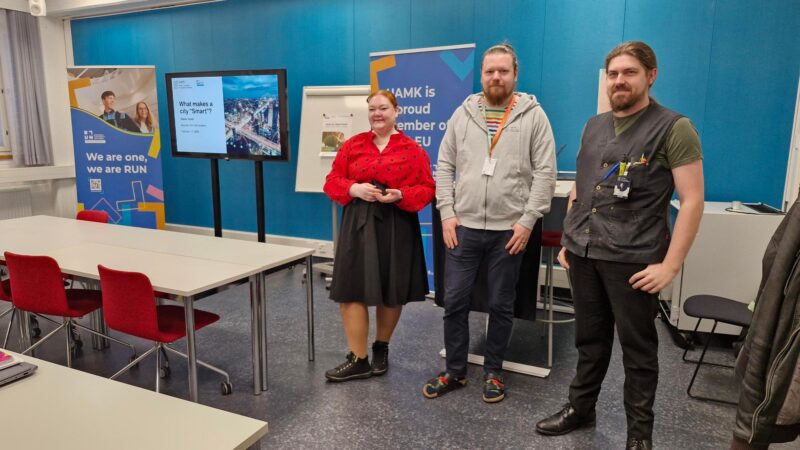
“Put yourself in their shoes. See things with a fresh set of eyes,” Mikkonen told students at the outset.
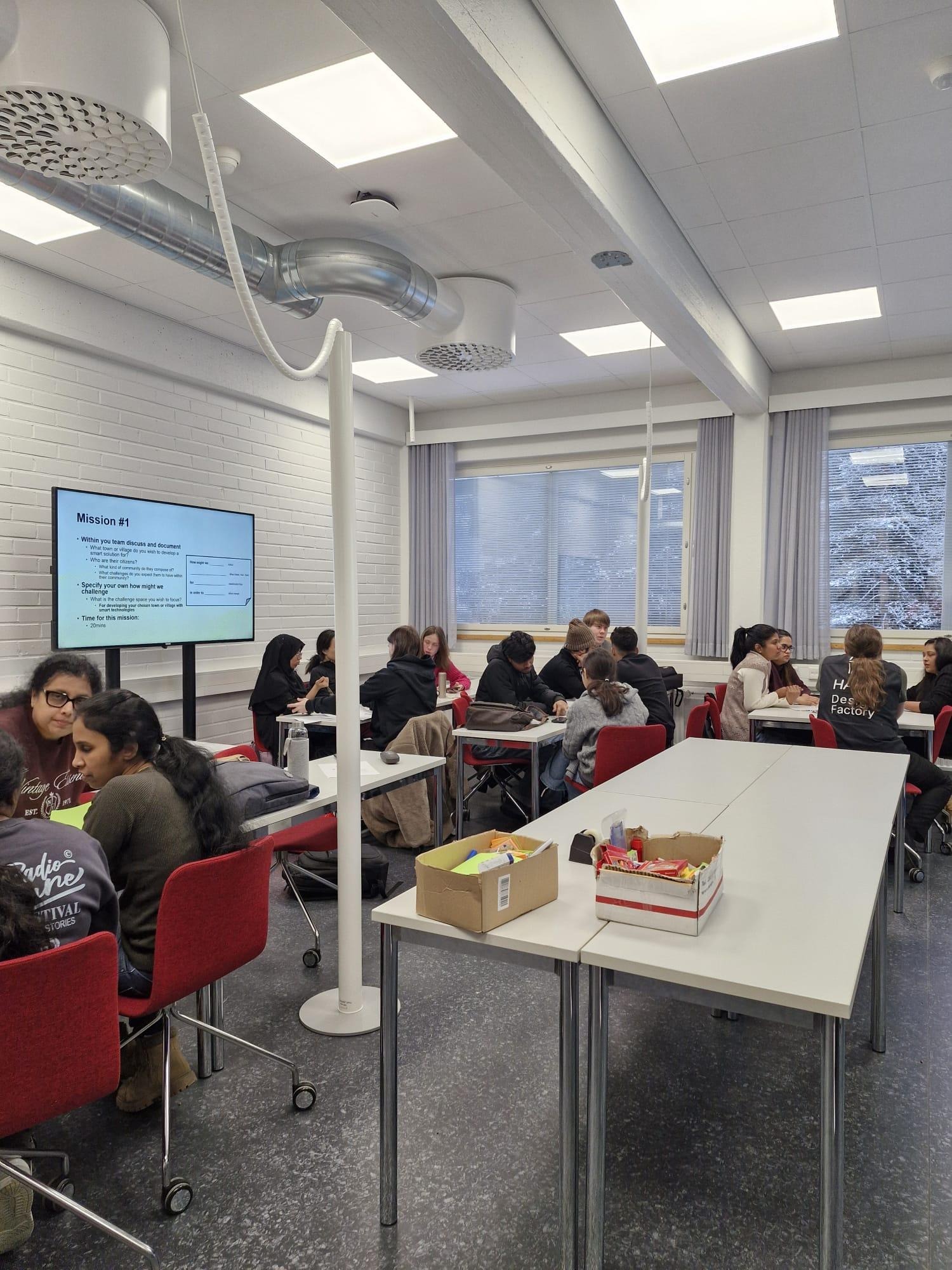
Teams spent Day 1 identifying their users, who lives in the place they chose, what do they need, what makes their daily life harder than it needs to be; before moving through rapid cycles of ideation, prototyping, and revision. Mikkonen pushed them to generate wild ideas, discard their favourites, and keep iterating based on any user-based research they could gather during the first day. By afternoon, four abstract brainstorms had become four concrete proposals with reasoning gathered from interviews and online data.
Day 2 was about communication. If a solution can’t be explained clearly in three minutes, it doesn’t matter how good it is. Students spent the morning learning visual storytelling, pitch structure, and information design. Finally, during the afternoon refining and rehearsing, incorporating feedback in real time before presenting to Aino Nissinen, Urban Planner from the City of Riihimäki.
Four Solutions
One team proposed a smart monitoring system for elderly residents in Riihimäki, not intrusive surveillance, but a system that learns the natural rhythm of a person’s day and quietly flags when something seems wrong. The goal: let older people live independently, with safety built into the background of their lives rather than imposed on top of it.
Another team tackled Taobat in Pakistan’s Neelum Valley, where dangerous mountain roads and chronic power failures don’t just inconvenience residents, they compound into systemic barriers to safety and opportunity. Their solution was ambitious and layered, addressing connectivity across infrastructure, energy, and communication simultaneously. Complex, but deliberately so: the problem demanded it.
A third team focused on public transportation in Riihimäki, and what set them apart was the research they’d done the day before. They had gone out and spoken to actual residents about their experiences. When Nissinen heard their pitch, she recognized the issues immediately. These were problems she works on every day.
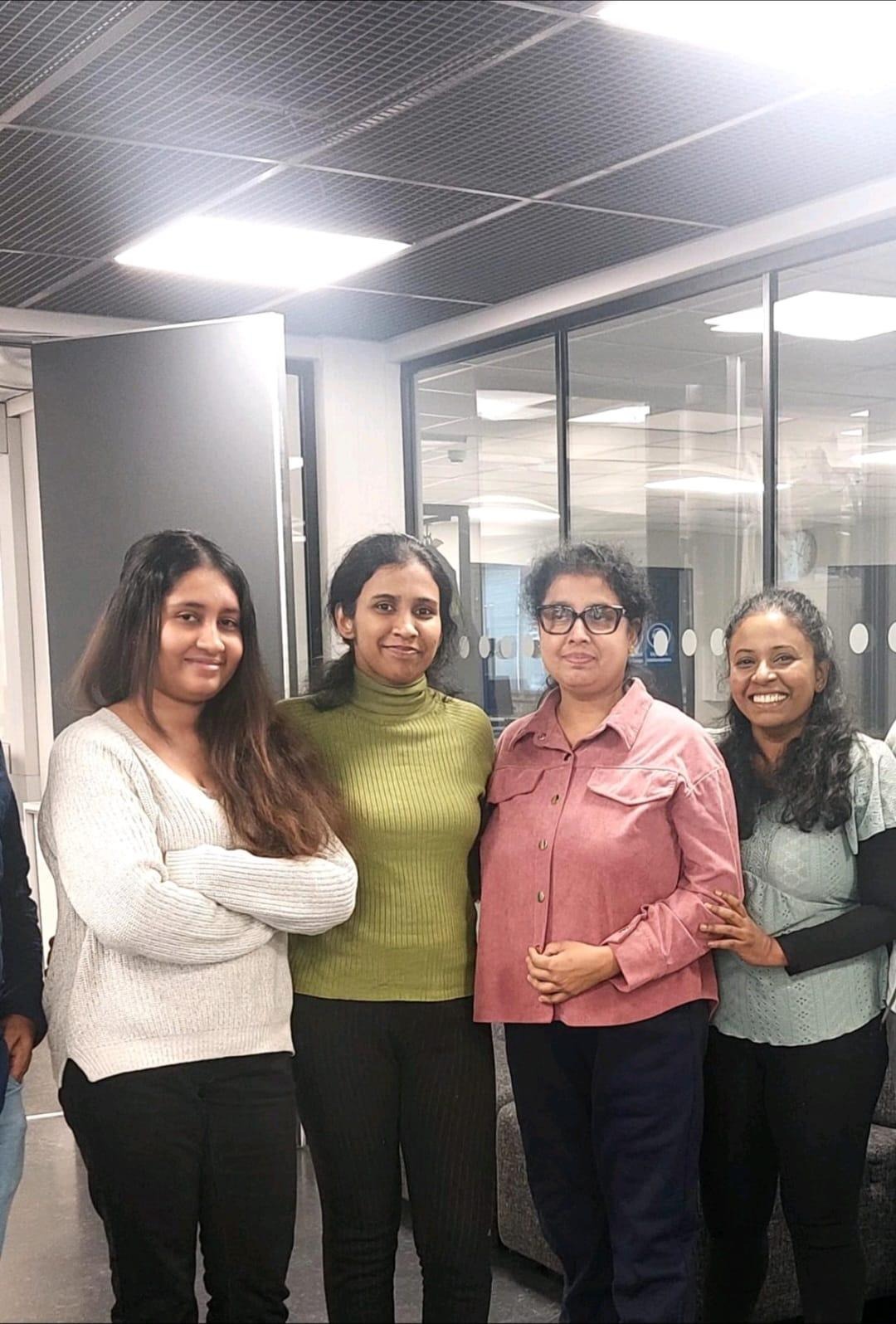
The winning team went furthest from home on the map, but in another sense, they knew exactly where they were going. Achini Hewage, Sachini Pelikankanamalage, Ranga Gamage, and Pushpa Wijesooriya are from Sri Lanka. They chose to focus on Tissamaharama, a region they understand from the inside based on the community needs and what they could bring out into the market for a larger customer base. This product being buffalo curd, which is a speciality and has deep cultural roots in Tissamaharama and is produced in significant quantities but sold almost entirely within the local area. Their proposal as a solution was for a smart delivery network that would expand market reach, increase producer income, and create new jobs in the region.
What made their team win wasn’t just the idea, it was the innovative thinking and user understanding behind the solution proposition. Nissinen also noted that the model was innovative, scalable, and replicable, not a one-product fix, but a framework that could be adapted to other industries, other regions, other countries. The pitch itself was composed and cohesive. Every team member spoke. The flow was seamless.
The Winning Team at RUN-EU Webinar
The nervousness that filled the room before the pitches gave way to something steadier by the end. Students asked follow-up questions of each other’s teams. They absorbed Nissinen’s feedback. They had spent two days becoming genuinely invested in problems that weren’t theirs, in places some of them had never been, and it showed.
“The RUN-EU spirit lies within the students and in working together, inspiring others to succeed”, says Milla Koivulahti, HAMK’s RUN-EU Project Coordinator and FILS lead, who facilitated the event.
The winning team will now receive specialist training in video pitch production and present their solution to a European audience at an international RUN-EU webinar in April 2026.
The INNOTHON format; intensive, collaborative, anchored in real-world problems, is running across all ten RUN-EU partner universities throughout spring 2026, each one tackling the same theme: Smart Cities, Smart Villages.
What HAMK’s students demonstrated is that innovation doesn’t require prior expertise. It requires curiosity, a willingness to listen, and two days of being genuinely uncomfortable with easy answers.
The INNOTHON is part of Future Innovators Labs (FILS), a collaborative initiative within RUN-EU. The FILS connects innovation centres across Europe: Ireland, Portugal, Finland, Netherlands, Austria, Spain, Belgium, Czechia and Romania, offering hands-on learning in STEM, social innovation, and entrepreneurship.
More Information


RUN European University
We are part of RUN European University, which brings together ten European higher education institutions from nine countries committed to a common vision.