HAMK and CONTAI develop AI support for patients awaiting evacuation
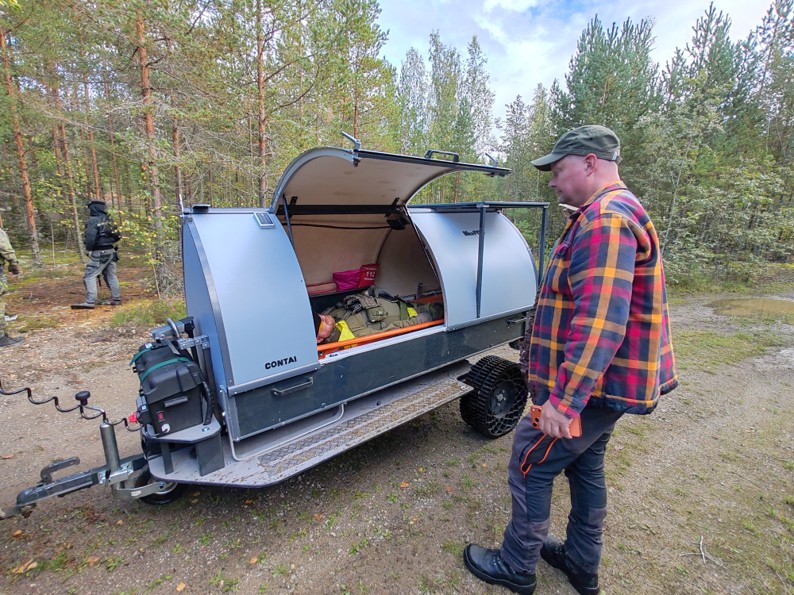
Häme University of Applied Sciences (HAMK) and transport technology company CONTAI are developing an AI assistant for the MedPOD evacuation module to help guide patients and monitor their condition. The aim is to collect data on the patient’s condition while they wait for evacuation and during transport, and to make this information available to medical staff later.
On the front line and in disaster areas, it is not always possible to transport injured people to medical care immediately. Help may be delayed, and those assisting injured people may also be putting themselves at risk. Developed by CONTAI, MedPOD is a dual-use evacuation module that can be transported by an unmanned ground vehicle (UGV) or a conventional towing vehicle. According to CONTAI, the module is intended to support patient care and keep injured people warm while they wait for evacuation, as well as provide protection against threats such as drone attacks. Once transport is possible and safe, the patient can be evacuated in the same module.
MedPOD is also a logistics solution. The modules are intended to deliver supplies to the front line and provide storage there, and to evacuate injured people on return journeys. This would allow the modules to be prepositioned where they may be needed. The aim is for injured people to have access to MedPOD while they are still waiting to be evacuated.
An AI assistant to support patient guidance and monitoring
HAMK is responsible for developing the AI application for MedPOD. The pilot, carried out as part of the FIN-SIM project, aims to develop an assistant that would guide patients in setting up a sensor, such as a smartwatch, to monitor their condition. The application would monitor and record readings from the sensor, such as heart rate and blood oxygen saturation, and periodically ask patients how they are feeling.
Providing guidance on self-care at an early stage can already help a great deal, as can monitoring changes in the patient’s condition and collecting data for further care.
“The solution is dual-use, meaning it is suitable for both defence and civilian applications. It could be used, for example, in major accidents where there are not enough medical personnel available. Providing guidance on self-care at an early stage can already help a great deal, as can monitoring changes in the patient’s condition and collecting data for further care,” says Mikael Bowellan, Project Manager of FIN-SIM.
This would provide information about the patient’s condition before they reach a medical facility. When the patient arrives at a field hospital or another care facility, medical staff would have access to information on how their condition has changed during the wait and transport. Making this information available is also intended to help patients receive care more quickly.
The system requires expertise from several fields
CONTAI’s system consists of several elements: vehicles, including unmanned ground vehicles, communication and navigation systems, and various load applications. According to Seppo Narinen, one of the company’s co-founders, MedPOD is the most challenging of these to date, with no ready-made solution or components available.
The company’s core expertise and intellectual property rights relate to a unique physical and autonomous logistics process. This represents an entirely new level of autonomous capability, in a category the company calls UGL, Unmanned Ground Logistics.
HAMK brings highly specialised and distinctive expertise to the system.
“We cannot cover every specialist application area ourselves. The entire CONTAI system depends on a network of experts in different modules, and HAMK is now bringing highly specialised and distinctive expertise to the system,” Narinen says.
“For HAMK and the FIN-SIM project, this pilot offers a really interesting use case that fits our expertise well. It also reflects the direction we want to take HAMK AI Lab,” Bowellan says.
Narinen’s vision for the future goes beyond patient guidance and monitoring.
“In the future, MedPOD could be something like an autonomous intensive care unit, if we could equip it with all the devices we want and train the AI to use them.”
According to Narinen, both MedPOD and the FIN-SIM project have attracted considerable international attention. He also emphasises the importance of concrete development work for the company’s business:
“Only concrete applications and processes lead to customer relationships.”
The prototype has been tested in the field
MedPOD’s design takes into account both the wait for evacuation and transport in challenging conditions. Its enclosed structure is designed to provide the patient with protection from fragments. The module has heating, an audiovisual system and enough room to sit up while waiting for evacuation.
According to CONTAI, successful tests carried out in 2026 have covered positioning MedPOD, transferring a person into the module on a stretcher, and transporting the module off-road. Tests took place at the Halli training area during a MILSIM exercise with DDE and Millog, and at Valavia’s Sääksmäki training area. The equipment used included a tracked unmanned ground vehicle, an all-terrain vehicle (ATV) and an off-road trailer.
“Our capability has been recognised as being at TRL 5,” Narinen says. The technology readiness level (TRL) scale describes technological maturity on a scale from 1 to 9. At level 5, the technology has been validated in an environment relevant to its intended use.
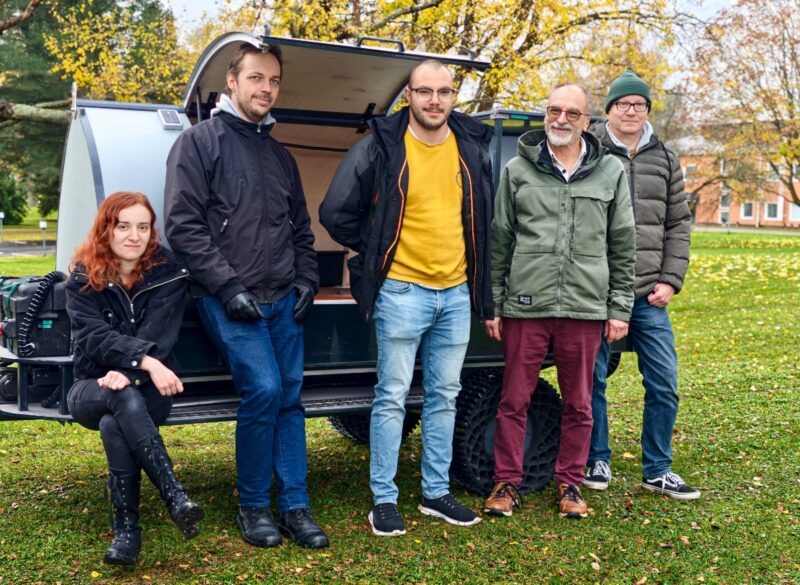
CONTAI develops transport and cargo-handling solutions for civilian and defence applications. The company demonstrated its MedPOD prototype at HAMK’s Hämeenlinna campus in October. During the visit, participants explored the device and reviewed the plans for the pilot. A demonstration video filmed on campus also attracted widespread interest: HAMK Research’s Instagram post received 1.4 million views.
FIN-SIM
The collaboration is part of FIN-SIM – Simulation and test environment establishment for unmanned devices, a project in which HAMK develops and tests solutions for unmanned systems together with companies. Running from 2026 to 2027, the project is co-funded by the European Union.


For more information: