The Blue Economy (Grantham Research Institute on Climate Change and the Environment, 2024) involves the sustainable use of marine and freshwater resources to create economic opportunities and local jobs while protecting aquatic ecosystems. Although the concept is primarily associated with coastal and marine areas, its principles also apply to inland regions, particularly in protecting freshwater ecosystems, improving water-use efficiency, and developing new products from aquatic resources. For Häme University of Applied Sciences (HAMK), participating in the Regional University Network – European University (RUN-EU) Innovation Meets Regions event on the Blue Economy provided an opportunity to share expertise, to learn from solutions developed in other regions, and to explore how these ideas can contribute to research, education, and sustainable regional development in Kanta-Häme.
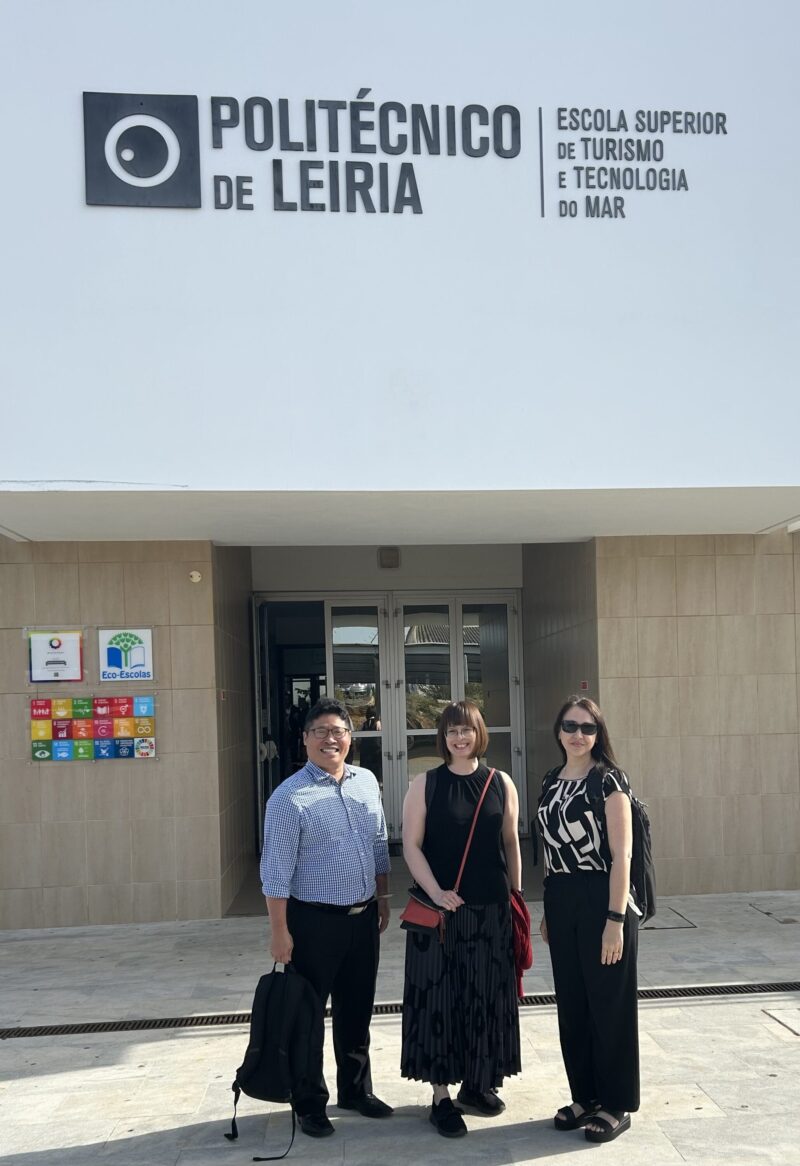
The RUN-EU is an alliance of ten higher education institutions across nine countries, dedicated to promoting regional development, innovation, and sustainable transition through collaborative education and research. As part of this mission, the RUN-EU held the Innovation Meets Regions (IMR) event on the Blue Economy in Peniche, Portugal, from 26 to 29 May 2026 (Polytechnic University of Leiria, 2026; RUN-EU, 2026). Hosted by the Polytechnic University of Leiria (Image 1) through the School of Tourism and Maritime Technology, the event brought together higher education institutions, research organizations, companies, and other regional as well as international stakeholders to explore opportunities for sustainable development, innovation, and creation of new business within the Blue Economy sector. A multidisciplinary delegation from HAMK, representing research, education, management, regional development and students, participated in the event to showcase HAMK’s activities, to exchange expertise, and to build connections with Blue Economy actors from different regions.
Blue Economy and Regional Development
Throughout the event (Polytechnic University of Leiria, 2026; RUN-EU, 2026), presentations, discussions, workshops, and site visits demonstrated how the Blue Economy brings together research, innovation, environmental sustainability, business operations, industry activities, tourism, and even water sports such as surfing. Participants explored how the sustainable use of marine and freshwater resources can create economic opportunities, community engagement, and general wellbeing, while addressing environmental challenges and regional development. The programme also illustrated that Blue Economy development depends on collaboration among research institutions, companies, public sector actors, non-governmental organisations, and local communities.
Peniche and the Oeste Region of Portugal were presented as an emerging Blue Economy hub where strong links among marine resources, local industry, and research institutions create opportunities for innovation and sustainable growth. This setting functioned as a living laboratory for Blue Economy innovation, providing a practical context for understanding how regional ecosystems can translate scientific knowledge into real-world applications. Visits to local companies, including SEAentia, Flying Sharks, and SeaForester, provided inspirational and highly diverse examples of Blue Economy activities ranging from the production of high-quality fish in recirculating aquaculture systems, transportation of living marine animals to public aquaria all over the world, and replanting seaweed forests using innovative seaforestation techniques to restore ocean ecosystems. Although the activities differ considerably, each combines research, innovation and technological development with the sustainable use or management of aquatic resources.
From HAMK’s perspective, the event highlighted the importance of applied, practice-oriented approaches and intersectoral collaboration in supporting sustainable transition and regional development. While Peniche’s innovations are rooted in the Atlantic coast, similar principles are also relevant to landlocked regions such as Kanta-Häme. At HAMK, relevant research areas linked to the Blue Economy include sustainable management of freshwater systems, lake restoration, industrial water treatment and water recirculation, as well as the use of aquatic resources, such as microalgae, for new products and applications. Efficient water use is also important in food production, where water treatment, process development, and valorisation of side streams can help reduce resource use and support circular economy solutions. These themes are being explored in ongoing HAMK projects such as Funter – Sustainably produced functional bio-based materials in health products (HAMK, n.d.-e.), BioVesi – Boosting sustainability in industrial water treatment using bio-based solutions (HAMK, n.d.-a), F3 – Food, Future, Fermentation (HAMK, n.d.-d.), and HÄMILIS – Waste to a Minimum, Added Value to a Maximum (HAMK, n.d.-c). Importantly, discussions during the event also created new research contacts, including with researchers from the Polytechnic University of Leiria, and these encounters resulted in plans for research visits and further discussions on joint research activities and future collaboration.
Technology showcase by HAMK
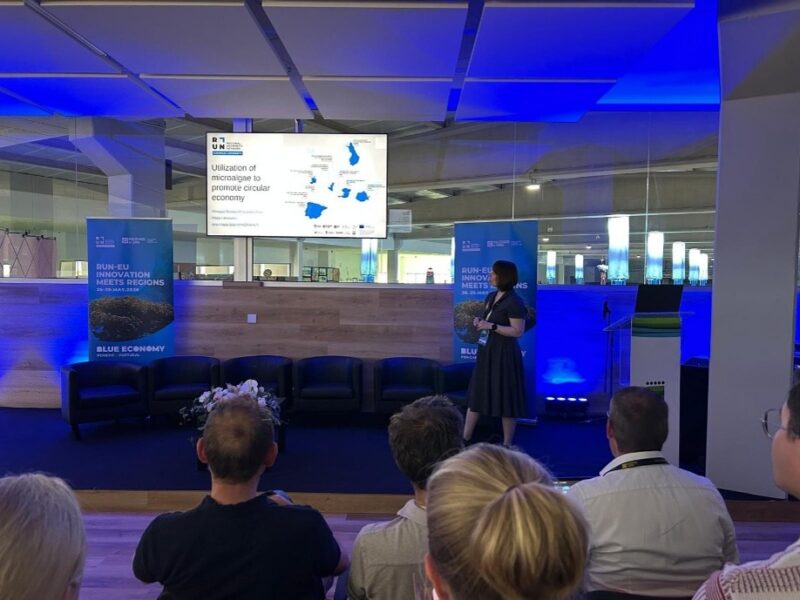
HAMK participated in the RUN-EU Technology Showcase by presenting research and development activities, education, and innovations to an international audience. At the showcase, Aino-Maija Lakaniemi’s technology pitch, “Utilisation of microalgae to promote circular economy” (Image 2), highlighted the various benefits of microalgae as sustainable raw materials for a range of applications such as cosmetics, pharmaceuticals, food, feed, fertilisers, biostimulants, polymers, and fuels. As important steps toward wider adoption of microalgal technologies and the use of microalgae in commodity products, she emphasised the importance of maintaining consistently high areal or volumetric productivity over long periods and synergistically optimising all required process steps from cultivation to formulation of final products. Lakaniemi also introduced ongoing HAMK research projects related to microalgae, which include the Funter (HAMK, n.d.-e.) and BioVesi (HAMK, n.d.-a) projects that are both strongly linked to the Blue Economy. In the Funter project, microalgae, which are tiny aquatic organisms able to grow through photosynthesis, are explored as potential natural raw materials for cosmetics and health products due to their fast growth rates and ability to produce various health-promoting compounds such as pigments, phenolic compounds, and phytosterols. In the BioVesi project, microalgae’s ability to utilise nutrients (e.g., nitrogen and phosphorus) and simple organic compounds (e.g., sugars) from various industrial waste and side streams is explored as a potential approach for food industry side stream valorisation. The efficiency of selected microalgae in removing nutrients and organic loading from different water streams, while at the same time producing valuable microalgal biomass, is estimated to create an efficient water treatment concept.
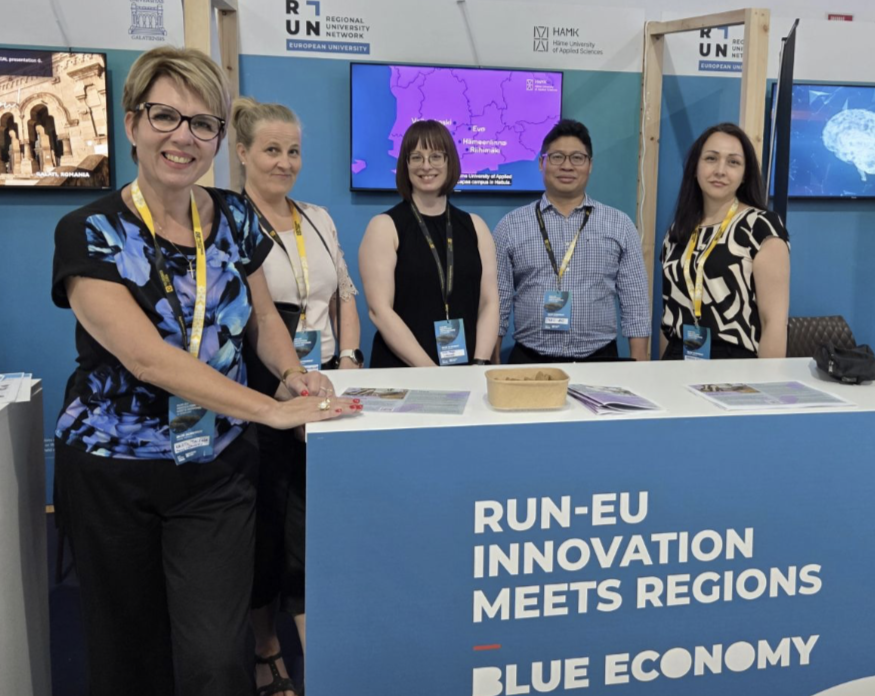
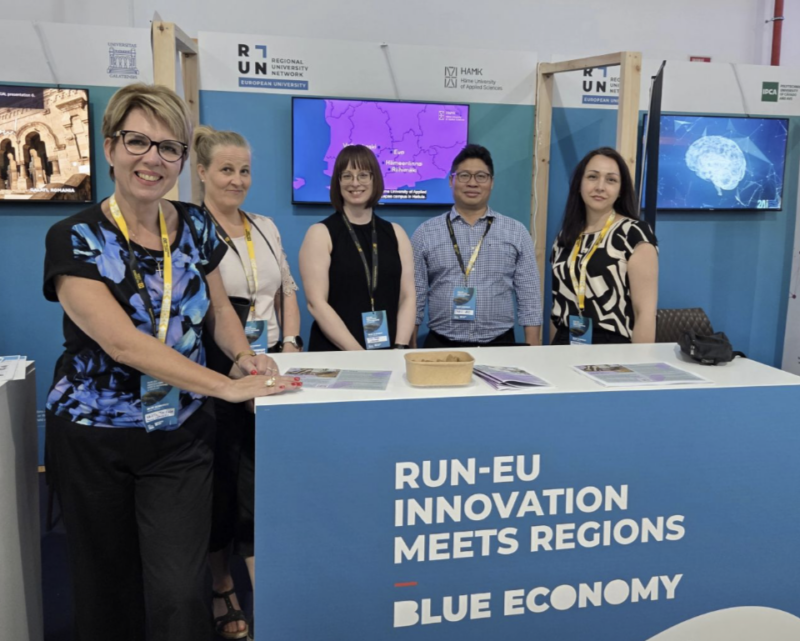
At the interactive HAMK stand (Image 3), lively discussions with visitors, from fellow researchers to the local public, focused on ongoing research and development projects, including JTF Biomass – Transition from peat production to peat-free horticultural and agricultural products (HAMK, n.d.-f), F3 (HAMK, n.d.-d.), and HÄMILIS (HAMK, n.d.-c.). In the HÄMILIS project, brewery side streams such as spent grain and spent yeast are explored as raw materials for value-added food ingredients and products, while the F3 project investigates fermentation technologies to improve the utilisation of plant-based raw materials. Together, these activities contribute to the Blue Economy by promoting the circular and resource-efficient use of biological resources and underutilised side streams to create higher-value products. The stand was part of the technology exhibition organized concurrently with the Biennial of the Sea at the multipurpose Pavilion in Peniche. This vibrant public event brought the Blue Economy directly to the community, attracting not only international scientists and companies but also local schools, families and citizens.
Another key highlight was the showcasing of edible spoons as an example of sustainable product innovation by HAMK students. These spoons were originally developed through HAMK’s Design-Based Education approach, a way of learning the skills needed in working life by working in close collaboration with companies to solve real-life challenges (HAMK, n.d.-f). In the case of the edible spoons, a group of two biotechnology and food engineering students and two sustainable development students worked together on a project commissioned by a company partner, Jokioisten Leipä. The concept centred around utilising dried breadcrumbs as a raw material, demonstrating how food production side streams can be valorised into functional products (HAMK, 2026). This concrete product innovation example served as a strong discussion opener at the HAMK stand and inspired many conversations about potential research collaboration and study opportunities for exchange students interested in studying at HAMK.
Networking opened doors for future collaboration
The event highlighted how expertise developed in marine and coastal settings can inform research and innovation in inland freshwater environments, and vice versa. Although these environments differ, they share challenges related to water quality, sustainable use of aquatic resources, water treatment and circularity. Furthermore, the participating institutions have complementary research infrastructure and expertise, creating opportunities to examine shared Blue Economy challenges from different environmental and technological perspectives.
Face-to-face exchanges with RUN-EU partner institutions identified common research interests and laid the groundwork for future collaboration. Initial conversations have already paved the way for future project collaborations and bilateral student and staff exchanges. A visit to Polytechnic University of Leiria (CeteMares Building, Center for Research & Development, Training and Dissemination of Maritime Knowledge) further supported these interactions by offering insight into the host institution’s facilities, research environment, and ongoing research activities. Together, HAMK’s expertise and infrastructure related to freshwater research and circular bioeconomy solutions, and the marine expertise and facilities available within the network, could support comprehensive research extending across both contexts. The visit highlighted multiple shared research interests, which sparked initial discussions about future collaboration opportunities.
Turning connections into collaboration
The experience in Peniche showed that the value of the RUN-EU alliance lies in its power to turn brief encounters into long-term strategic value, bringing together expertise, infrastructure, and regional perspectives that would otherwise remain separate. Marine and inland freshwater environments face many common challenges and expertise developed in either ecosystem may provide new approaches to the other. Face-to-face discussions, company visits and opportunities to explore research facilities helped participants to identify these complementary strengths and to consider how they could be applied interchangeably.
Ultimately, digital communication cannot replace the spark of face-to-face personal connections. For HAMK, the insights gained, the research ideas shared, and the relationships forged in Portugal have led to new research contacts, plans for research visits, and further discussion on potential joint activities. These concrete connections provide a basis for developing Blue Economy collaboration that combines marine and freshwater expertise in research, education, innovation activities and regional development.
Acknowledgements
We acknowledge the other participants from HAMK for their work in promoting HAMK and Kanta-Häme region activities at the RUN-EU Innovation Meets Regions event. The delegation included Krista Taipale, a representative of the regional council of Häme, and from HAMK Vice President Heidi Ahokallio-Leppälä, Research and Innovation Director Annukka Pakarinen, Head of Development Katja Maetoloa, RUN-EU project manager Saara Lindén, and Communications Specialist Jaana Siljamäki. The team was further supported by HAMK’s student representatives Helena Eslon, Walteri Pernu, and Leila Lustig. The writing of this article was supported by funding from the European Union through European Regional Development Fund with Helsinki-Uusimaa Regional Council and Regional Council of Häme as the funding agencies (Funter, HAMK, n.d.-e), from Business Finland (BioVesi; HAMK, n.d.-a.), Regional Council of Häme through the AKKE funding programme (F3; HAMK, n.d.-d), the European Union through European Regional Development Fund with Regional Council of Häme and Regional Council of Päijät-Häme as the funding agencies (HÄMILIS; HAMK, n.d.-c), and the European Union through Economic Development Centre (JTF Biomass; HAMK, n.d.-f).
References
- Grantham Research Institute on Climate Change and the Environment. (December 11, 2024). What is the blue economy? London School of Economics and Political Science. Retrieved October 8, 2026 from https://www.lse.ac.uk/granthaminstitute/explainers/what-is-the-blue-economy/
- HAMK. (May 5, 2026). Opiskelijat innovoivat syötävän lusikan. Retrieved June 8, 2026 from https://www.hamk.fi/opiskelijat-innovoivat-syotavan-lusikan/
- HAMK. (n.d.-a). BioVesi – Boosting Sustainability in Industrial Water Treatment Using Bio-Based Solutions. Retrieved June 15, 2026 from https://www.hamk.fi/en/projects/biovesi-boosting-sustainability-in-industrial-water-treatment-using-bio-based-solutions/
- HAMK. (n.d.-b). Design-based education (DBE). Retrieved September 30, 2026 from https://www.hamk.fi/en/about-hamk/pedagogical-research-and-development/design-based-education-dbe/
- HAMK. (n.d.-c). HÄMILIS – Waste to a Minimum, Added Value to a Maximum. Retrieved June 16, 2026 from https://www.hamk.fi/en/projects/hamilis/
- HAMK. (n.d.-d). F3 – Food, Future, Fermentation. Retrieved June 16, 2026 from https://www.hamk.fi/projektit/f3/
- HAMK. (n.d.-e). Funter – Sustainability produced functional biobased material in health products. Retrieved June 15, 2026 from https://www.hamk.fi/en/projects/sustainably-produced-functional-bio-based-materials-in-health-products-funter/
- HAMK. (n.d.-f). Transition from peat production to peat-free horticultural and agricultural products. Retrieved June 15, 2026 from https://www.hamk.fi/en/projects/transition-from-peat-production-to-peat-free-horticultural-and-agricultural-products/
- Polytechnic University of Leiria. (2026). RUN-EU Innovation Meets Regions and Biennial of the Sea. Retrieved June 8, 2026 from https://www.ipleiria.pt/en/run-eu-innovation-meets-regions-and-biennial-of-the-sea/
- RUN-EU. (March 19, 2026). RUN-EU Innovation Meets Regions on Blue Economy at IPLeiria. Retrieved June 8, 2026 from https://run-eu.eu/2026/03/19/run-eu-innovation-meets-regions-on-blue-economy-at-ipleiria/
Authors
About the project
This article relates to the following projects: BioVesi – Boosting Sustainability in Industrial Water Treatment Using Bio-Based Solutions, HÄMILIS – Waste to a Minimum, Added Value to a Maximum, F3 – Food, Future, Fermentation, Funter – Sustainability produced functional biobased material in health products, and Transition from peat production to peat-free horticultural and agricultural products. Links to the websites for these projects can be found in the references list at the end of this article.